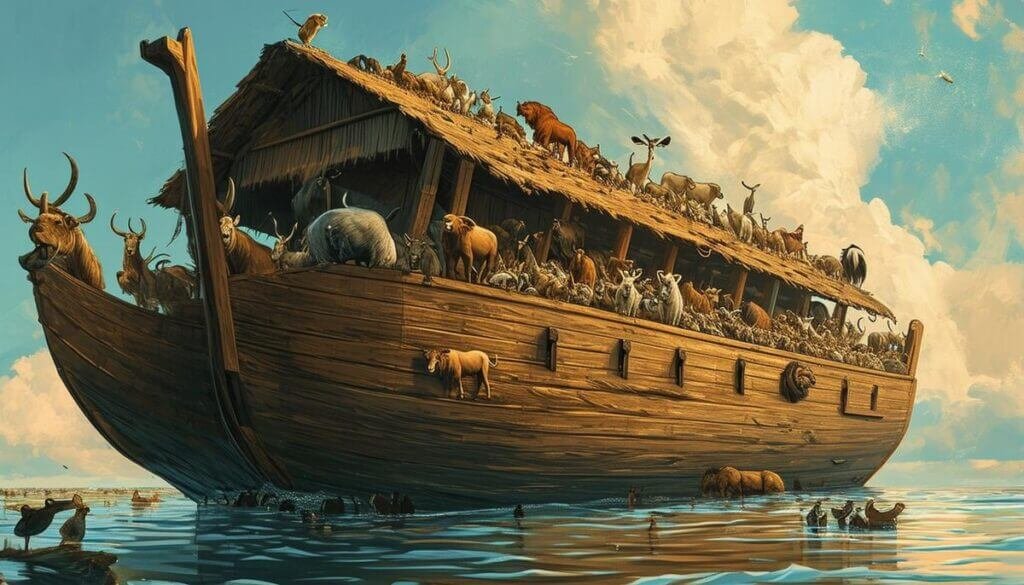
A reflection on faith, patience, and endurance through divine guidance
Nuh (A.S): Perseverance in the Face of Ignorance

Introduction
Among the many Prophets mentioned in the Qur’an, Prophet Nuh (peace be upon him) stands as a timeless symbol of perseverance, patience, and devotion. His story is not merely a historical account; it is a mirror reflecting the struggle of truth against stubborn denial. For nearly a millennium, Nuh (AS) called his people to righteousness, enduring mockery, rejection, and isolation — yet he never abandoned his mission.
“Indeed, We sent Noah to his people, and he said, ‘O my people, worship Allah; you have no deity other than Him. Indeed, I fear for you the punishment of a tremendous Day.’”
(Surah Al-A‘raf 7:59)
The Divine Call: Faith Above Tradition
Prophet Nuh (peace be upon him) was sent at a time when idolatry and moral corruption had become deeply rooted among his people. Generations had passed since the message of Tawhid (oneness of Allah) was forgotten. People worshipped false gods, seeking worldly benefit over divine truth. In this atmosphere of spiritual darkness, Allah sent Nuh (A.S.) as a mercy and a warning — a messenger who spoke with unwavering clarity.
“We sent Noah to his people, and he said, ‘O my people, worship Allah; you have no deity other than Him. Indeed, I fear for you the punishment of a tremendous Day.’”
(Surah Al-A‘raf 7:59)
His message was simple, sincere, and persistent — a call to return to Allah with humility, to abandon the arrogance that blinds the heart, and to seek forgiveness before divine justice arrived.
“He said, ‘O my people, indeed I am to you a clear warner. Worship Allah and fear Him and obey me. He will forgive you of your sins and delay you for a specified term. Indeed, the time [set by] Allah, when it comes, will not be delayed, if you only knew.’”
(Surah Nuh 71:2–4)
Nuh (A.S.) delivered this call with deep compassion and endless patience. The Qur’an records his tireless effort — calling by day and night, in public and private, appealing to reason and conscience alike.
“He said, ‘My Lord, indeed I invited my people [to truth] night and day, but my invitation increased them not except in flight. And indeed, every time I invited them that You might forgive them, they put their fingers in their ears, covered themselves with their garments, persisted, and were arrogant with [great] arrogance.’”
(Surah Nuh 71:5–7)
Even as they turned away, he continued to remind them of the signs of Allah around them — the heavens, the rain, the earth, and the abundance of life — each a proof of the Creator’s mercy.
“Do you not see how Allah created seven heavens in layers and made the moon therein a [reflected] light and made the sun a burning lamp? And Allah has caused you to grow from the earth a [progressive] growth.”
(Surah Nuh 71:15–17)
Through these verses, we see that Prophet Nuh’s (A.S.) mission was not only to warn but also to awaken gratitude and reflection — to remind humanity that every blessing carries a call to faith.
Facing Rejection: Patience Beyond Measure
Despite his sincerity, Nuh (peace be upon him) was met with arrogance and ridicule. His people dismissed him as a mere human and accused him of falsehood. But instead of responding with anger, Nuh (A.S.)exercised extraordinary patience — a patience rooted in deep faith and trust in Allah.
“Every time I called them that You might forgive them, they put their fingers in their ears, covered themselves with their garments, persisted, and were arrogant with [great] arrogance.”
(Surah Nuh 71:7)
He endured this rejection for centuries — 950 years according to the Qur’an — highlighting that perseverance is measured not in comfort or popularity, but in steadfastness toward a righteous purpose.
“And We certainly sent Noah to his people, and he remained among them a thousand years less fifty years; and the flood seized them while they were wrongdoers.”
(Surah Al-‘Ankabut 29:14)
Even after decades of rejection, Nuh (A.S.) continued to pray for his people’s guidance, demonstrating that patience includes compassion and hope for others, even when they persist in wrongdoing:
“And [Noah] said, ‘My Lord, do not leave upon the earth from among the disbelievers an inhabitant. Indeed, if You leave them, they will mislead Your servants and not beget except evil and disbelief.’”
(Surah Nuh 71:26–27)
The Qur’an also records that Nuh’s (A.S.) persistence was a model for all who strive in the path of truth, showing that enduring hardship while maintaining faith is a central virtue:
“So We saved him and those with him in the ship, and We made it a sign for the worlds.”
(Surah Al-Ankabut 29:15)
Through these verses, it becomes clear that true perseverance is active, patient, and morally grounded. It is not simply enduring hardship, but continuing to speak truth, to act righteously, and to seek guidance for oneself and others, despite persistent rejection.
“Indeed, We thus reward the doers of good.”
(Surah Al-A‘raf 7:42) — a reminder that patient perseverance, aligned with faith, is never overlooked by Allah.
The Ark: A Vessel of Obedience

When his people refused to believe, Allah commanded Nuh (peace be upon him) to build an ark — a task that drew further mockery from disbelievers. Yet he followed Allah’s guidance faithfully, demonstrating that obedience to God must take precedence over human opinion.
“And construct the ship under Our observation and Our inspiration. Do not address Me concerning those who have wronged; indeed, they are to be drowned.”
(Surah Hud 11:37)
The Qur’an emphasizes that the Ark was not merely a physical vessel but a symbol of trust and submission to Allah. By obeying the divine command, Nuh (A.S.) prepared for a test whose magnitude only Allah knew.
“And We carried him on Our eyes. A reward for him who was denied. Indeed, he was a grateful servant.”
(Surah Al-Mu’minun 23:27–28)
The Ark also embodies the principle that divine instruction guides toward salvation, even when human perception sees only hardship or ridicule. The Qur’an notes that pairs of animals, along with Nuh’s (A.S.) family and believers, were brought safely aboard:
“And We saved him and those with him in the ship, and We made it a sign for the worlds.”
(Surah Al-Ankabut 29:15)
Furthermore, the story underscores that obedience to Allah is inseparable from faith. Even as mockers laughed and refused guidance, Nuh’s (A.S) unwavering compliance was a model for generations:
“So We inspired him: Construct the ship under Our observation and inspiration, and when Our command comes and the water rises, sail in it as a sign of Our mercy, while it becomes a lesson for those who reflect.”
(Paraphrased from Surah Hud 11:36–37; the Qur’an stresses divine instruction and purpose.)
Through these verses, the Ark is not just a vessel; it is a test, a means of salvation, and a timeless lesson in obedience, trust, and reliance upon Allah. It reminds believers that following divine guidance, even when misunderstood or mocked by the world, leads ultimately to safety, wisdom, and spiritual success.
The Flood and Divine Justice
As the floodwaters rose, truth was separated from falsehood. Those who mocked Nūḥ were destroyed, while the believers found safety aboard the Ark. The story reminds us that divine justice may be delayed, but it is never denied.
“So We opened the gates of the heaven with rain pouring down and caused the earth to burst with springs, and the waters met for a matter already predestined.”
(Surah Al-Qamar 54:11–12)
Timeless Lessons from Nūḥ’s Life
Faith requires endurance: Holding to truth in a world of disbelief demands courage.
Obedience over opinion: True wisdom lies in following divine guidance even when others mock.
Patience is power: Nuh’s (A.S.) patience was not weakness — it was a form of strength anchored in hope.
Success is in sincerity, not numbers: Despite few followers, Nuh (A.S.) fulfilled his duty before Allah.
Conclusion
The story of Prophet Nuh (peace be upon him) continues to inspire believers to remain steadfast amid challenges. His patience in the face of ignorance shows that truth is not defeated by disbelief — it is strengthened by perseverance. When faith is anchored in sincerity, even the storms of rejection become vessels of salvation.
“And it was said, ‘O earth, swallow your water, and O sky, withhold [your rain].’ And the water subsided, and the matter was accomplished, and the ship came to rest upon the [mountain of] Judiyy, and it was said, ‘Away with the wrongdoing people.’”
(Surah Hud 11:44)