Select Page

Exploring the Cosmos: A Journey Through the Stars

Exploring the Mysteries of the Cosmos

The exploration of the cosmos has long been one of humanity’s greatest intellectual pursuits. Through astronomy, we seek to comprehend the structure, origins, and evolution of the universe. Among the most significant subjects of this study are stars — luminous bodies that illuminate the heavens, govern galactic dynamics, and play a central role in the chemical evolution of the cosmos. Remarkably, the Qur’an also invites humanity to reflect upon these celestial phenomena, emphasizing both their beauty and their function as signs (āyāt) of divine wisdom.

The Birth of Stars: A Cosmic Wonder

The Genesis of Stars in Molecular Clouds

From a scientific perspective, stars are born in dense regions of interstellar gas and dust known as molecular clouds. Under the force of gravity, matter contracts until nuclear fusion ignites at the core, transforming a protostar into a stable, luminous body. This complex process demonstrates the delicate balance between gravitational compression and thermal expansion, producing the characteristic stability and brightness of main-sequence stars.

The Qur’an describes this act of creation with profound simplicity:

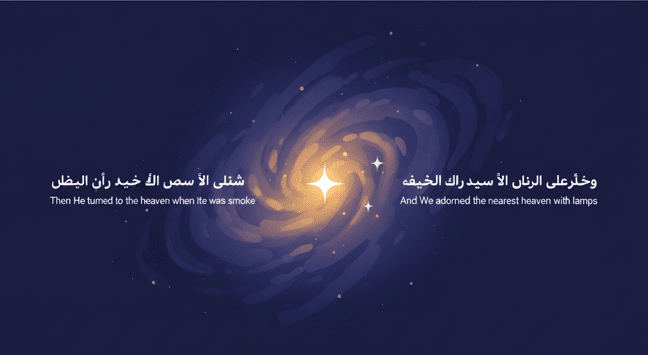
“Then He turned to the heaven when it was smoke and said to it and to the earth, ‘Come willingly or unwillingly.’ They said, ‘We come willingly.’
So He completed them as seven heavens in two days and revealed to each heaven its command; and We adorned the nearest heaven with lamps and as protection. That is the determination of the Exalted in Might, the Knowing.”
(Surah Fussilat 41:11–12)

This passage illustrates that the heavens and stars were not left in disorder but were created with precision and purpose, governed by divine command.

Modern astrophysics interprets the term “smoke” (dukhān) as a poetic reference to the primordial gaseous state of the universe — an idea that aligns remarkably with contemporary cosmological models describing the formation of stars and galaxies from interstellar gas.

The Evolution and Stability of Stars

When hydrogen in a star’s core becomes depleted, the internal balance between gravity and pressure begins to shift. For stars similar in mass to the Sun, this leads to an expansion into the red giant phase, during which the outer layers are gradually expelled into space, forming a planetary nebula, while the remaining core contracts into a white dwarf. This transformation is not chaotic but follows precise physical laws that reflect remarkable stability and order in the universe.

Furthermore, understanding stellar nucleosynthesis — the process by which elements are formed through nuclear fusion reactions inside stars — helps to explain the origin of the chemical diversity observed throughout the cosmos. The very atoms that make up Earth and all living beings were once forged in the cores of ancient stars.

From a Qur’anic perspective, this harmony and preservation are signs of divine design. Despite the immense number of stars and their life cycles, Allah has established a balanced and secure system between the heavens and the Earth.

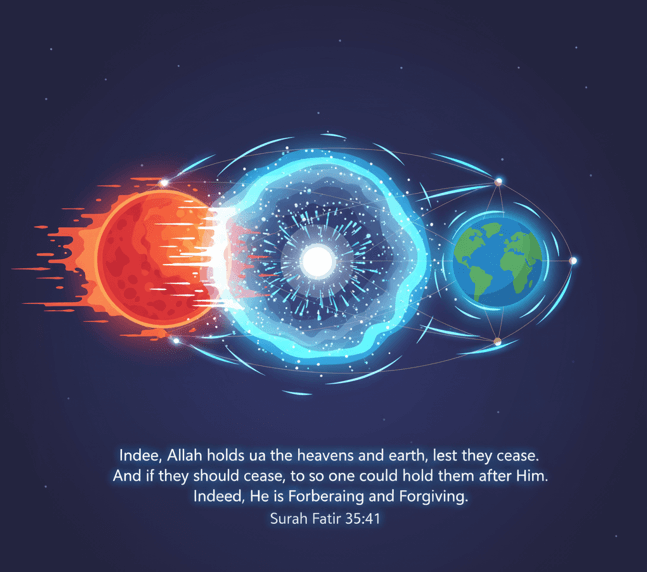
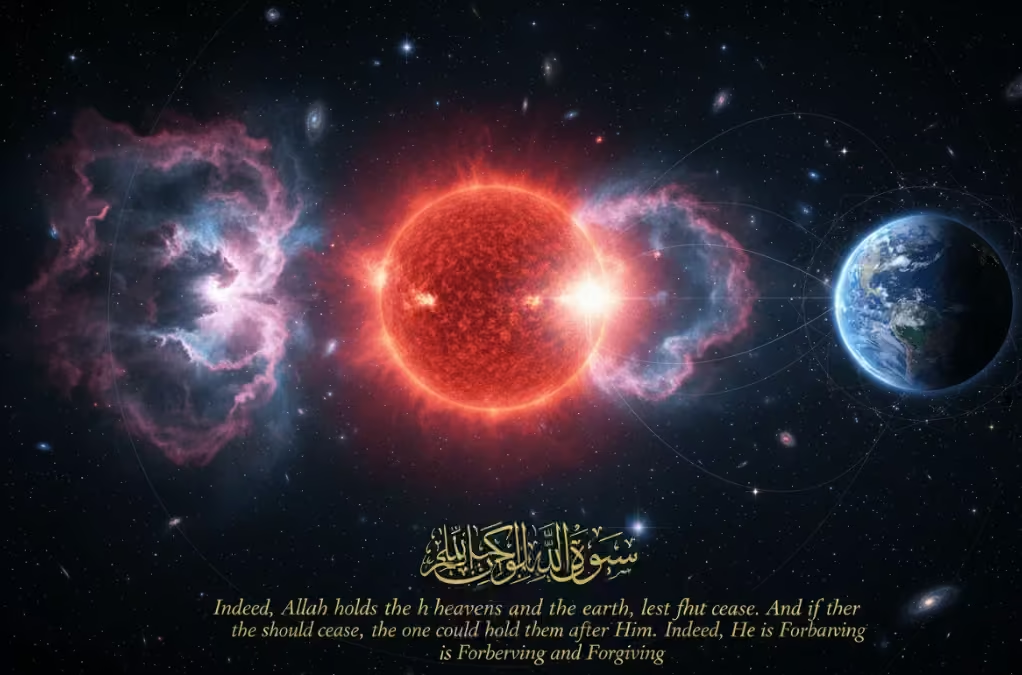
“Indeed, Allah holds the heavens and the earth, lest they cease. And if they should cease, no one could hold them after Him. Indeed, He is Forbearing and Forgiving.”
(Surah Fatir 35:41)

This verse beautifully reflects the concept that, although countless stars are born and destroyed across the universe, their processes do not disrupt the stability of our planet or the cosmic order. The precision with which these phenomena occur reveals the wisdom and power of the Creator, who has made the heavens and the Earth a perfectly regulated system.

The Dance of Stars

Stellar Life Cycles

Stars, the celestial bodies that illuminate our universe, undergo fascinating life cycles. Beginning as dense molecular clouds, they evolve into radiant entities like red giants and eventually transform into white dwarfs. This stellar evolution is a testament to the intricate balance maintained in the cosmos, a balance that extends to the divine protection of our Earth. As stars expand and contract, they play a crucial role in sustaining the equilibrium of our planet’s environment, showcasing the harmonious interplay between cosmic forces and divine wisdom.
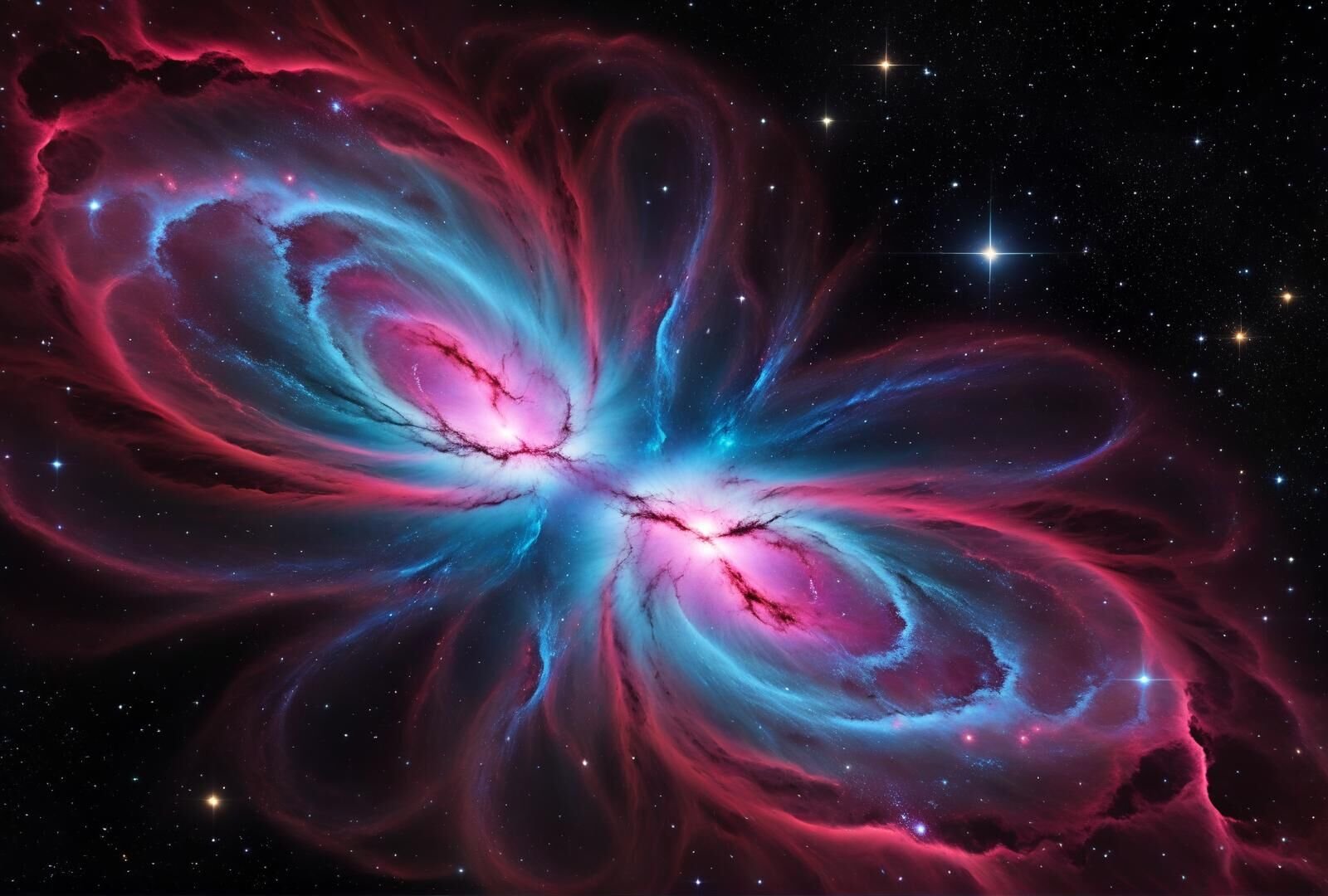
Red giants, with their expansive atmospheres, mark a significant phase in a star’s life. As they shed their outer layers, they contribute to the cosmic material that forms new stars and planets. This cycle of birth, death, and rebirth is a reflection of the universe’s continuous renewal, a process that ensures the stability of our solar system. White dwarfs, the remnants of these giants, serve as a reminder of the universe’s enduring nature, embodying the balance that sustains life on Earth.
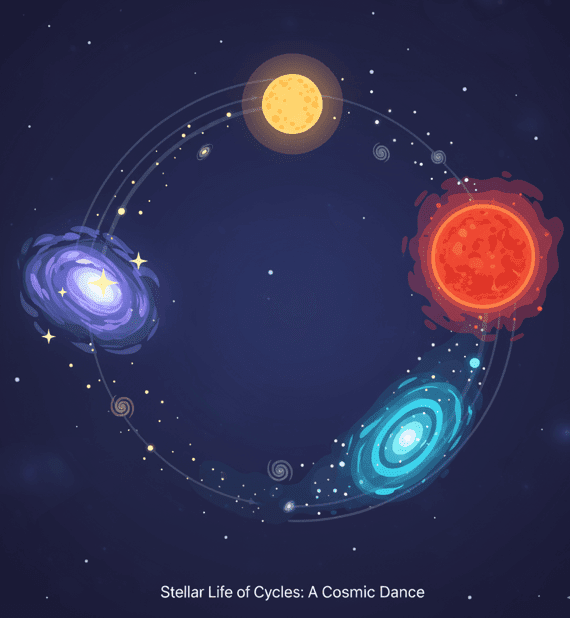
In this cosmic dance, the divine protection of Earth’s balance is evident. The precise conditions that allow life to flourish on our planet are maintained through the intricate processes of stellar evolution. This divine orchestration highlights the unity between the natural world and the spiritual insights found in sacred texts, offering a profound understanding of our place in the universe.

The Cycle of Cosmic Renewal

Stellar Death and Cosmic Renewal

The end of a star’s life is as significant as its birth. When a massive star exhausts its nuclear fuel, its core collapses under gravity, triggering a supernova — one of the most powerful explosions in the universe. This cataclysmic event disperses heavy elements such as carbon, oxygen, silicon, and iron into the interstellar medium, enriching it with the materials necessary for the formation of new stars, planets, and ultimately, life itself. Lighter stars end their lives more quietly, fading into white dwarfs, while the most massive collapse further into neutron stars or black holes, objects of extraordinary density and gravitational power.

This continuous cycle of creation, transformation, and renewal demonstrates the self-sustaining nature of the universe. Even in destruction, there is purpose — the remnants of old stars become the seeds of new worlds. Modern astrophysics reveals that every atom in the human body originated from these cosmic processes, reminding us that we are, quite literally, made of stardust.

The Qur’an reflects this same principle of renewal and divine order:

“He merges the night into the day and merges the day into the night, and He has subjected the sun and the moon, each running its course for an appointed term. That is Allah, your Lord; to Him belongs all dominion.”
(Surah Fatir 35:13)

This verse mirrors the scientific understanding of constant cosmic motion and balance. Just as day and night alternate in perfect rhythm, so too do the stars live, die, and give birth to new generations in harmony with divine decree. Allah’s creation operates under laws of precision and stability — a testament to His wisdom and might.

The Harmony of Science and Revelation

Unity of Knowledge and Faith

In the vast expanse of the universe, the intricate dance of celestial bodies speaks to a profound harmony that echoes the unity of science and faith. As we delve into the mysteries of the cosmos, we find that the principles governing the stars and galaxies mirror the divine wisdom articulated in sacred texts. This cosmic order is not just a testament to scientific laws but also a reflection of a higher purpose and design.

The Qur’anic verses, when viewed through the lens of modern astrophysics, reveal a remarkable alignment with scientific discoveries. They invite us to ponder the signs in the heavens and the earth, urging a deeper understanding of the universe’s creation and maintenance. This synergy between revelation and empirical evidence enriches our comprehension of both realms, bridging the gap between the seen and the unseen.

As we explore the celestial phenomena, from the birth of stars to their eventual demise, we are reminded of the divine wisdom that sustains the balance of the cosmos. This reflection not only enhances our appreciation of the natural world but also strengthens our faith in the interconnectedness of all things. The unity of knowledge and faith is a guiding principle that inspires us to seek truth and wisdom in every corner of the universe.

The Qur'an

The Harmony of Science and Revelation (Conclusion)

  • Reflects on the unity between science and faith.

  • Summarizes cosmic order and divine wisdom.

  • Includes verse (Surah Āl ‘Imrān 3:190).

Conclusion

The exploration of the cosmos through the study of stars reveals not only the physical processes that shape the universe but also the signs of divine order that govern it. From the formation of stars in molecular clouds to their evolution, death, and rebirth, every stage reflects a system of remarkable balance and beauty.

Science explains the mechanisms of these processes, while the Qur’an provides the spiritual context — reminding humanity that these celestial wonders are not random occurrences but purposeful signs (āyāt) of the Creator’s power.

“Indeed, in the creation of the heavens and the earth, and in the alternation of the night and day, are signs for those of understanding.”
(Surah Āl ‘Imrān 3:190)

Through both observation and reflection, one can see that the laws governing the stars and galaxies are manifestations of divine perfection. The heavens serve not only as a field of scientific inquiry but also as a reminder of our place within an ordered and purposeful universe. The harmony of cosmic phenomena — their formation, evolution, and renewal — embodies the unity between scientific discovery and spiritual understanding, leading humankind toward deeper appreciation of the Creator who sustains all existence.

The exploration of the cosmos through the study of stars reveals not only the physical processes that shape the universe but also the signs of divine order that govern it. From the formation of stars in molecular clouds to their evolution, death, and rebirth, every stage reflects a system of remarkable balance and beauty.

Science explains the mechanisms of these processes, while the Qur’an provides the spiritual context — reminding humanity that these celestial wonders are not random occurrences but purposeful signs (āyāt) of the Creator’s power.

“Indeed, in the creation of the heavens and the earth, and in the alternation of the night and day, are signs for those of understanding.”
(Surah Āl ‘Imrān 3:190)

Through both observation and reflection, one can see that the laws governing the stars and galaxies are manifestations of divine perfection. The heavens serve not only as a field of scientific inquiry but also as a reminder of our place within an ordered and purposeful universe. The harmony of cosmic phenomena — their formation, evolution, and renewal — embodies the unity between scientific discovery and spiritual understanding, leading humankind toward deeper appreciation of the Creator who sustains all existence.