
Read & Riser
Chapter Three
Abraham Among the Nations:
Echoes of the Fire in Abrahamic Memory
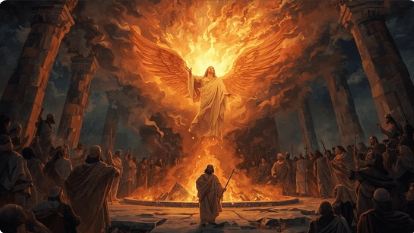
Abraham in the Furnace – a classic depiction from Jewish manuscript tradition
Introduction
In the luminous narrative of Prophet Ibrahim (peace be upon him), the miracle of the fire stands as a pinnacle of divine intervention—a testament to tawḥīd’s unassailable strength against the flames of tyranny and falsehood. As recounted in the Qur’an with crystalline clarity, the fire that was meant to consume him became a sanctuary of coolness and peace (Surah Al-Anbiyāʾ 21:69). Yet this episode, so vividly preserved in Islamic revelation, resonates beyond the confines of one tradition. Echoes of the same story—Abraham’s defiant stand against idolatry and his miraculous deliverance from a furnace—appear in the oral and interpretive legacies of Judaism and Christianity, though not always enshrined in their canonical scriptures.
This final chapter of our exploration invites reflection on these shared threads, honouring the profound unity of the Abrahamic faiths while gently illuminating their distinct emphases. Drawing from classical sources, we trace how Ibrahim/Abraham emerges as a universal archetype: the hanīf who shatters idols, the faithful servant tested by fire, and the spiritual forefather whose legacy binds humanity in a covenant of monotheism. In an age of division, these converging narratives remind us that truth, like fire, can refine rather than destroy, calling us to a common pursuit of the Divine.
The Furnace in Jewish Tradition: Midrashic Flames of Defiance
Judaism reveres Abraham (Avraham Avinu, “our father Abraham”) not merely as a historical figure, but as the foundational patriarch whose unyielding faith birthed the covenantal nation of Israel. While the written Torah (the Five Books of Moses) omits the dramatic tale of the fiery trial—focusing instead on his call from Ur of the Chaldeans (Genesis 12:1–3) and the covenants of promise and circumcision (Genesis 15 and 17)—the story flourishes in the rich soil of Jewish oral traditions, known as Midrash. These interpretive expansions, compiled in texts like Midrash Bereishit Rabbah and the ancient Book of Jubilees (a second-century BCE retelling of Genesis), fill the scriptural gaps with vivid narratives that underscore Abraham’s role as the first monotheist.
In these accounts, a young Abraham confronts the polytheism of his Mesopotamian homeland. His father, Terah (Tārakh in Hebrew), is depicted as a prominent idol-maker, crafting statues for the marketplace—a detail echoing the Qur’anic reference to Azar (Surah Al-Anʿām 6:74). Disgusted by the lifelessness of these creations, Abraham smashes the idols in Terah’s workshop, leaving the largest one intact with the hammer in its grasp, much like the Islamic tradition. Enraged, King Nimrod (often portrayed as a tyrannical ruler claiming divine status) sentences him to death by fire in the furnace of Ur Kasdim—“the fire of the Chaldeans.”
The Holy One, blessed be He, said to the fire: “I created you to give warmth and light, not to harm My servant.”
— Midrash Bereishit Rabbah 38:13
The deliverance is miraculous: the flames part like water, or transform into a verdant garden where Abraham emerges unscathed, sometimes aided by an angel. This narrative emphasises Abraham’s intellectual rebellion against idolatry—reasoning that a created object cannot create harm—and his divine election as the progenitor of Israel through Isaac. Though not canonical, this story permeates Jewish liturgy and folklore, reinforcing Abraham as the archetype of emunah (faith) that withstands trial.
The Echo in Christian Tradition: A Foreshadowing Through Faith
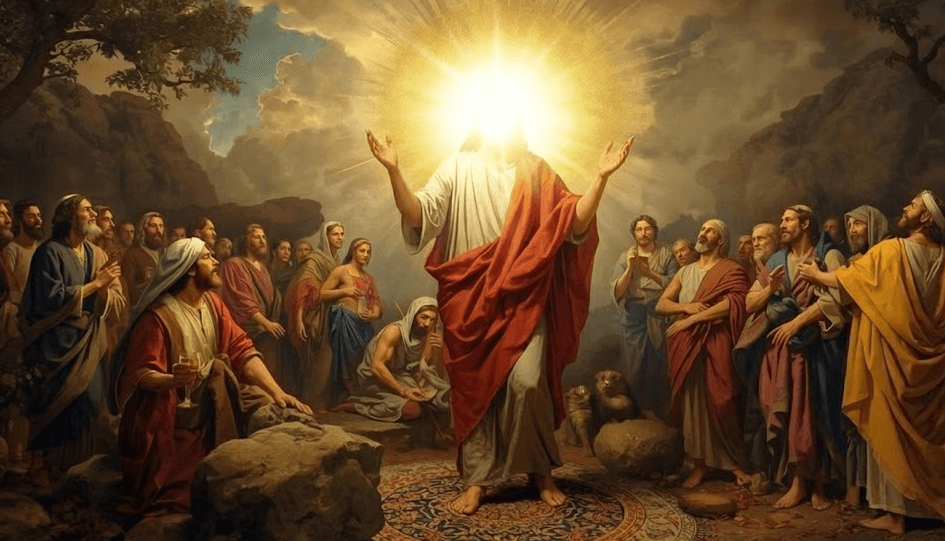
Abraham Receives the Three Angels – Rembrandt van Rijn (1646), often interpreted with Christological significance in Christian tradition
Christianity, too, holds Abraham in exalted esteem, not as a national patriarch, but as the spiritual forefather of all believers, justified by faith alone (Romans 4:16–17). The canonical New Testament draws heavily from Genesis, portraying Abraham’s trust in God’s promises—countless descendants and blessing to all nations (Genesis 12:2–3)—as a prototype for salvation through Christ. Yet the fiery ordeal, absent from the Bible’s pages, lingers in the interpretive margins, inherited from Jewish midrashic sources and early Christian historians.
Writings like Pseudo-Philo’s Liber Antiquitatum Biblicarum (a first-century CE Jewish-Hellenistic text influential among early Christians) recount a version strikingly akin to the Midrash: Abraham’s destruction of idols in Terah’s shop, Nimrod’s wrath, and the furnace miracle where flames become harmless. Church Fathers such as Tertullian and Origen, familiar with these traditions, reference the story to illustrate divine providence.
In Christian theology, however, the emphasis shifts from the event itself to its symbolic resonance. Abraham’s trial foreshadows the ultimate sacrifice of Jesus, the “seed” through whom all nations are blessed (Galatians 3:16). The fire represents the refining crucible of faith, much as the Binding of Isaac (Akedah, Genesis 22) prefigures the Cross.
Convergence and Distinction: A Tapestry of Shared Reverence
Across these traditions, the furnace story weaves a tapestry of convergence: Abraham/Ibrahim as the bold iconoclast who exposes idolatry’s emptiness, the tested servant preserved by divine command, and the covenant-bearer whose legacy transcends bloodlines. All affirm monotheism’s triumph over tyranny—whether Nimrod’s furnace or Pharaoh’s decree—and celebrate a God who intervenes for the faithful.
Yet a gentle distinction emerges: Islam uniquely enshrines the fire miracle in revealed scripture, presenting it not as interpretive embellishment but as a luminous sign (āyah) for humanity (Surah Al-Anbiyāʾ 21:68–70). This preservation underscores the Qur’an’s role as the final clarifier, completing the prophetic chain from Abraham through Moses, Jesus, and Muhammad (peace be upon them all). Such variances enrich rather than divide, inviting dialogue: Judaism’s Midrash adds ethical depth; Christianity’s typology points to redemptive suffering; Islam’s revelation offers unadorned certainty.
Concluding Reflection: A Shared Father, a Universal Lesson
Prophet Ibrahim (peace be upon him) stands as the spiritual lodestar for billions, his furnace a metaphor for every trial that tempers faith. The story of his confrontation with idolatry and miraculous preservation teaches us a timeless truth: when a believer stands firmly upon tawḥīd, armed only with sincerity and trust in Allah, no force on earth can prevail against him.
The idols we face today may not be carved from stone, but they take the form of ego, materialism, societal pressure, and falsehoods disguised as truth. Like Ibrahim, we are called to shatter them with reasoned courage, knowing that pride blinds hearts while humility opens them to guidance.
Above all, this episode reminds us that Allah’s protection is absolute: when we place our reliance solely in Him, even the fiercest trials become places of peace, and apparent defeat is transformed into eternal victory. May we inherit even a fraction of Ibrahim’s unshakeable certainty and fearless devotion.
Ameen.
As we conclude this journey through the emergence of the hanīf, the breaking of the idols, and their echoes across traditions, let us remember Qur’an 2:136:
قُولُوا آمَنَّا بِاللَّهِ وَمَا أُنزِلَ إِلَيْنَا وَمَا أُنزِلَ إِلَىٰ إِبْرَاهِيمَ وَإِسْمَاعِيلَ وَإِسْحَاقَ وَيَعْقُوبَ وَالْأَسْبَاطِ...
“Say, ‘We believe in Allah and what has been revealed to us and what was revealed to Abraham, Ishmael, Isaac, Jacob, and the tribes...’”
In Abraham’s light, may the paths converge once more in worship of the One.
Leave a Comment
Logged in as Bushra. Edit your profile. Log out