
The Journey to Mina: Taking Ismail from Home and Overcoming Iblis's Temptations 🕋
Chapter Second
After receiving the divine command through his dream and consulting with his son Ismail (عليه السلام ) (who willingly submitted to Allah’s will, as described in the Quran: “Then when the boy reached the age to work with him, Abraham said, ‘O my dear son! I have seen in a dream that I ˹must˺ sacrifice you. So tell me what you think.’ He replied, “O my father! Do as you are commanded. Allah willing, you will find me steadfast” [Quran 37:102]), Prophet Ibrahim (عليه السلام ) prepared to carry out the sacrifice. He approached his wife Hajra ( رحمة الله Rahmat Allah) , Ismail’s mother, to take the boy from their home in Mecca. According to traditional narrations, Ibrahim (عليه السلام ) informed Hajra ( رحمة الله Rahmat Allah) that he was taking Ismail (عليه السلام ) out for a purpose, without fully disclosing the details to avoid causing her undue distress initially. Hajra(عليه السلام )Rahmat Allah), trusting in Ibrahim(عليه السلام ) ‘s prophethood and devotion to Allah, consented, though her maternal instincts would soon be tested.
The Journey to Mina: 🕋

With Ismail (عليه السلام ) by his side, Ibrahim (عليه السلام ) began the journey from their home in the valley of Mecca toward Mina, a nearby location designated for the act of sacrifice. This short but profound trek symbolized the ultimate test of faith, obedience, and detachment from worldly attachments. As they set out, they encountered temptations from Iblis (Satan), who sought to dissuade them from fulfilling Allah’s command. Iblis appeared three times along the path, attempting to exploit their emotions—paternal love, filial duty, and maternal concern—to sow doubt and prevent the sacrifice.
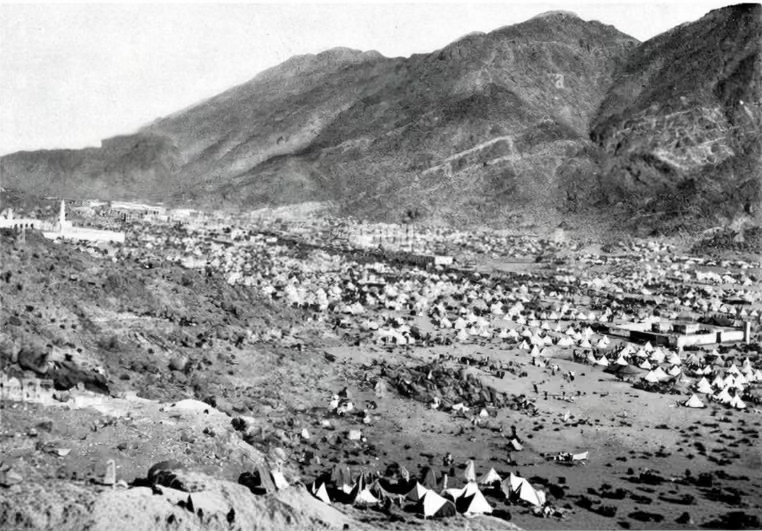
According to a narration reported by the classical scholar Al-Azraqi (a historian of Mecca who died in 250 AH/865 CE), the sequence unfolded as follows: Iblis first approached Ibrahim (عليه السلام ), whispering doubts like, “Are you really going to slaughter your beloved son based on a dream?” Ibrahim (عليه السلام ), recognizing the deception, rejected Iblis by pelting him with seven stones. Undeterred, Iblis then turned to Ismail (عليه السلام ), trying to instill fear and rebellion by saying, “Why follow your father into this? Save yourself!” Ismail (عليه السلام ), steadfast in his faith, also stoned Iblis with seven pebbles. Finally, Iblis went to Hajra ( رحمة الله Rahmat Allah) (who, in some accounts, was following at a distance or was approached separately at home), urging her to intervene and stop her husband and son, appealing to her motherly love: “How can you let them go to such a fate?” Hajra ( رحمة الله Rahmat Allah), too, repelled him by throwing stones.
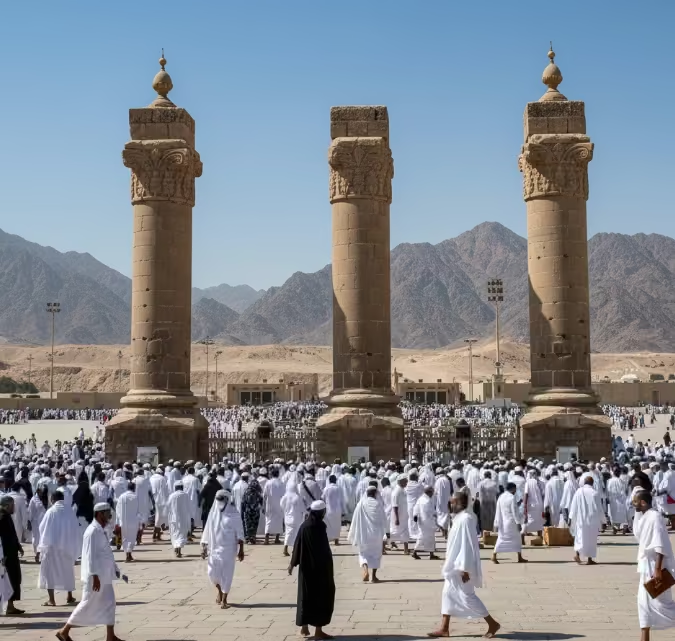
These three encounters occurred at specific spots now marked by the three pillars (Jamarat) in Mina: al-Jamrah al-Kubra (the largest), al-Jamrah al-Wusta (the middle), and al-Jamrah al-Sughra (the smallest). Each time, the family members cast seven stones at Iblis, symbolizing the rejection of Satan‘s whispers and the triumph of submission to Allah over temptation. This event is supported by Hadith narrations, such as one in Musnad Ahmad (reported by Imam Ahmad ibn Hanbal, d. 241 AH/855 CE), where it states: “When Ibrahim was taking his son to be sacrificed, Satan appeared before him at three locations, and each time Ibrahim repelled him by throwing seven pebbles”. Classical scholars like Ibn Kathir (d. 774 AH/1373 CE) in his Tafsir elaborate on this, explaining that Iblis’s interventions targeted the entire family to disrupt the divine test, drawing from earlier prophetic traditions and emphasizing the role of Angel Jibril in instructing Ibrahim to stone the devil.
Despite these trials, Ibrahim and Ismail pressed on, undeterred. The journey to Mina, fraught with spiritual warfare against Iblis, underscored the themes of tawhid (monotheism), patience, and sacrifice. Upon arriving, Ibrahim prepared for the act, but Allah intervened with a ram as a substitute, honoring their obedience (Quran 37:107: “Then We ransomed his son with a great sacrifice”). This episode is commemorated annually during Hajj through the ritual of Rami al-Jamarat (stoning the pillars), reminding believers to cast away their own “inner Iblis“—doubts, desires, and distractions that hinder devotion to Allah. 🕋💫 ﷲ 💫🕋
Discover the full beauty of this trial of faith...