
Space-Based Observatories: Escaping Light Pollution
Humanity’s Outpost Amid Orbiting Wonders and Colossal Worlds
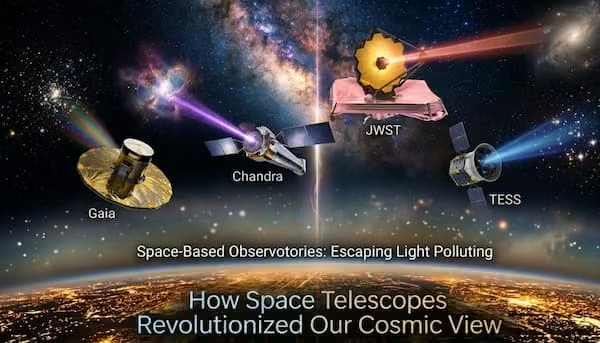
Space-Based Observatories: JWST, Gaia, Chandra & TESS escaping light pollution to unlock the universe.
Artificial light from cities has long created severe light pollution, washing out faint celestial objects and severely limiting even the best ground-based telescopes — even those located in remote dark-sky preserves. Atmospheric scattering, absorption of key wavelengths (ultraviolet, infrared, and X-rays), weather interruptions, and the day-night cycle further constrain Earth-bound observations.
Space-Based Observatories, positioned high above the atmosphere, operate in pristine darkness with uninterrupted views and continuous observation windows. Free from earthly hindrances, Space-Based Observatories deliver multi-wavelength data that is simply inaccessible from the ground, enabling transformative breakthroughs in stellar temperatures, magnetic activity, radiation bursts, and long-term cosmic variability.
Two iconic missions illustrate this power. The European Space Agency’s Gaia spacecraft has precisely mapped the positions, distances, and motions of more than 1.8 billion stars, completely revolutionizing our understanding of the Milky Way’s structure, stellar populations, and galactic dynamics. Meanwhile, NASA’s Transiting Exoplanet Survey Satellite (TESS) has discovered thousands of exoplanets by detecting tiny periodic dips in starlight, revealing a stunning diversity of worlds — from scorching hot Jupiters to rocky super-Earths — and providing essential statistics on planetary system architectures across the galaxy.
These advantages of Space-Based Observatories have fundamentally transformed modern astronomy, opening observational windows that were impossible from Earth’s surface.
Beyond these flagship missions, a fleet of specialized Space-Based Observatories has further enriched our cosmic perspective. NASA’s Chandra X-ray Observatory has exposed the violent high-energy universe, revealing supermassive black holes consuming matter, neutron star collisions, and the diffuse hot gas filling galaxy clusters. The Spitzer Space Telescope (now retired) and ESA’s Herschel Observatory unveiled hidden star-forming nurseries and distant galaxies obscured by cosmic dust in infrared light. Missions like the Fermi Gamma-ray Space Telescope continue to detect the most energetic events in the cosmos.
Collectively, these Space-Based Observatories have created a comprehensive, multi-wavelength portrait of the universe, dramatically accelerating discoveries while inspiring global public wonder and engagement with astronomy.
The Hidden Cost: How Satellite Megaconstellations Are Affecting Human Health and Behavior
While the rapid expansion of satellite megaconstellations has revolutionized global communications, internet access, and space-based astronomy with Space-Based Observatories, it is also introducing a planetary-scale form of artificial light at night (ALAN) that reaches even the most remote regions.
The same reflective satellites that create bright streaks in telescope images are steadily brightening twilight and pre-dawn skies, producing a diffuse skyglow never experienced in human history for Space-Based Observatories.
In 2025 and early 2026, leading sleep and circadian rhythm experts issued urgent warnings.
Joint statements from the European Biological Rhythms Society, the World Sleep Society, and Northwestern University’s Center for Circadian and Sleep Medicine highlighted that increasing orbital light pollution is fundamentally altering the natural light-dark cycle that governs human biology.
Even low-level illumination from satellites suppresses melatonin production — the hormone responsible for signaling the body to prepare for rest for those involved with Space-Based Observatories.
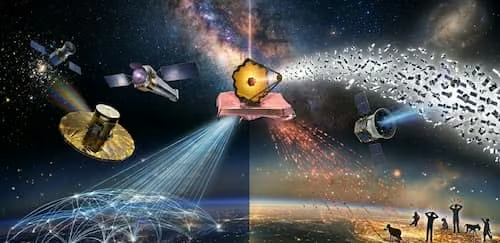
Satellite megaconstellations vs. space observatories: the growing impact on human health, behavior, and our view of the cosmos.
Key Health Impact
Short-term effects: Higher rates of insomnia, difficulty falling asleep, frequent night awakenings, daytime fatigue, impaired concentration and memory, slower reaction times, and reduced wound healing.
Long-term physiological risks: Chronic circadian misalignment is strongly linked to elevated chances of cardiovascular disease, obesity, type 2 diabetes, weakened immune function, mood disorders such as depression and anxiety, and certain types of cancer. Medical researchers now view these effects with the same seriousness as other major environmental health threats.
Behavioral and Cultural Consequences
Loss of night-sky wonder: For thousands of years, the pristine dark sky served as a shared source of storytelling, navigation, spiritual connection, and scientific inspiration. Hundreds of moving “stars” (satellites) visible during twilight are rapidly fading that ancient experience.
Decline in awe responses: Psychologists have documented reduced feelings of vastness and connectedness — emotions proven to boost mental well-being, creativity, empathy, and pro-environmental attitudes.
Threat to cultural heritage: Indigenous and rural communities are losing traditional star knowledge passed down through generations.
Shifting baseline syndrome: Younger generations increasingly accept a brighter, less starry sky as “normal,” slowly erasing collective memory of what has been lost.
Impact on future scientists: Children growing up under perpetually brighter skies may never develop the same intuitive bond with the cosmos that inspired countless astronomers, poets, and explorers.
These human-centered consequences reveal a critical tension at the heart of our space-age ambitions: the drive for connectivity and scientific progress must not come at the expense of public health, psychological well-being, and the very wonder that first motivated humanity to look upward.
Effective mitigation strategies are essential and include stricter satellite brightness regulations, lower and shorter-lived orbits, improved reflective materials, predictive scheduling tools, and international dark-sky protection agreements. Astronomers, satellite operators, public health experts, and policymakers must work together urgently to balance orbital innovation with responsible stewardship of the night sky.
Only through such coordinated global action can we ensure that humanity’s expanding presence in space truly enhances — rather than diminishes — both our connection to the cosmos and our own biological and cultural health.
The New Threat: Space Light Pollution from Satellite Megaconstellations
However, a major new challenge emerged prominently in 2025: artificial “space light pollution” caused by massive satellite constellations, led by SpaceX’s Starlink (now exceeding 10,000 active satellites, with global projections approaching hundreds of thousands). These low-Earth-orbit satellites reflect sunlight — especially during twilight hours — producing bright streaks and trails that contaminate telescope images.
A NASA-led study published in Nature in December 2025 modeled the impact on four major space telescopes using projected satellite populations of around 560,000 by the end of the decade. The results were sobering:
- Approximately 40% of Hubble Space Telescope images could be affected, averaging roughly 2 satellite trails per contaminated exposure.
- Future wide-field observatories face far worse disruption: NASA’s SPHEREx (launched March 2025 for cosmic history and exoplanet studies), ESA’s planned ARRAKIHS (focused on galaxy remnants and dark matter), and China’s Xuntian space telescope could see up to 96% of exposures contaminated, with dozens to over 90 streaks per image on average.
- Surface brightness levels from these trails are high enough to obscure or mimic faint astronomical signals, threatening core science goals such as all-sky surveys, deep imaging, and precise photometry.
These trails are often irreversible in raw data, complicating or entirely blocking critical research. The root cause lies in the satellites’ low-Earth orbits (typically 400–800 km altitude), where they remain sunlit long after ground-based twilight ends.
Mitigation efforts — including SpaceX’s use of darker materials, dielectric mirrors, and orbital adjustments — have modestly reduced brightness. In early 2026, SpaceX further announced plans to lower thousands of satellites to safer altitudes (around 480 km), accelerating natural deorbiting and potentially easing some interference. Yet these measures remain insufficient for the most sensitive instruments as constellations continue to grow.
This emerging crisis underscores an urgent need for sustainable orbital practices. Astronomers, satellite operators, regulators, and international bodies must collaborate on stricter brightness limits, lower orbits for faster decay, predictive avoidance scheduling, advanced data-processing algorithms to mask trails, and mandatory environmental impact assessments for new megaconstellations. Without coordinated global action, the very advantages that drove astronomy into space risk being undermined — dimming humanity’s clearest window on the universe just as we begin to explore it more deeply than ever before.
AI in Astronomy: Machines Uncovering Hidden Treasures
Modern astronomy now generates petabyte-scale data floods from telescopes like the Vera C. Rubin Observatory’s Legacy Survey of Space and Time (which began full operations in 2026 after first light in 2025).
Artificial intelligence has become an indispensable partner, rapidly classifying transients, correcting instrumental distortions, and discovering rare cosmic events that would otherwise remain buried in terabytes of nightly observations from Space-Based Observatories.
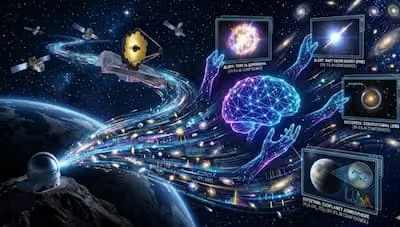
AI in Astronomy: Machines uncovering hidden cosmic treasures.
Google’s Gemini model, for example, achieved ~93% accuracy in identifying exploding stars, tidal disruption events, and asteroids using just 15 training examples — complete with transparent, human-interpretable explanations.
In parallel, Breakthrough Listen’s collaboration with NVIDIA developed a system that detects fast radio bursts 600 times faster than previous methods, slashing false positives by a factor of ten and enabling real-time alerts across global radio arrays linked to Space-Based Observatories.
AI is also advancing supernova science. While exact explosion timing still eludes full prediction, machine-learning algorithms now flag precursor signals (including potential black-hole-triggered events) and integrate multi-messenger alerts from gravitational waves, neutrinos, and electromagnetic radiation — creating a new era of predictive, holistic cosmic event tracking with Space-Based Observatories.
The impact extends far beyond transients. AI algorithms now process raw JWST spectra in seconds, automatically identifying subtle atmospheric molecules on exoplanets and correcting optical aberrations that once required weeks of manual analysis for Space-Based Observatories.
In galaxy surveys, deep-learning networks have uncovered thousands of previously hidden gravitational lenses — natural cosmic magnifiers that reveal distant objects and help map dark matter distribution with unprecedented precision.
Anomaly-detection systems scan Rubin’s massive data streams for “unknown unknowns,” flagging bizarre phenomena that human astronomers might overlook amid the deluge from Space-Based Observatories.
These tools are democratizing astronomy: citizen-science platforms now use AI assistance to let amateurs contribute meaningful discoveries from their own computers.
By accelerating discovery rates by orders of magnitude while reducing human bias, AI is transforming astronomy from a data-limited science into a discovery-rich discipline.
As next-generation telescopes come online, the synergy between human creativity and machine efficiency promises to unlock even deeper cosmic secrets — from the nature of dark energy to the chemical signatures of distant life through Space-Based Observatories.
Conclusion: Space-Based Observatories
Modern technology has utterly transformed astronomy, turning once-distant dreams into daily discoveries.
Space-Based Observatories soaring above Earth’s obscuring atmosphere deliver pristine, unblemished views free from weather, light pollution, and atmospheric absorption.
The James Webb Space Telescope, a prime example of Space-Based Observatories, has peered back to the universe’s infancy, unveiling unexpectedly bright early galaxies, possible direct-collapse black holes, new formation pathways for supermassive black holes, and tantalizing glimpses of Population III stars.
In 2025–2026 alone, JWST continued rewriting cosmology with record-breaking distant objects, detailed protoplanetary disks, vibrant star-forming regions, and exotic phenomena such as the “Little Red Dots.”
Ground-based observatories, strengthened by adaptive optics and remote dark-sky sites, remain essential partners.
Yet the rapid rise of satellite megaconstellations reminds us that space itself is no longer free of pollution.
While encouraging mitigation efforts by operators like SpaceX offer hope, sustained international cooperation is critical to protect both astronomical research and the human experience of the night sky.
Together, advanced Space-Based Observatories and powerful artificial intelligence are unlocking hidden cosmic treasures — from the cosmic dawn and the birth of galaxies to the atmospheres of distant worlds that may one day reveal signs of life.
These tools are working in remarkable harmony, accelerating discoveries at an unprecedented pace.
As we stand at the threshold of this extraordinary new era, humanity is better equipped than ever thanks to Space-Based Observatories to answer some of our most profound questions: How did the universe begin? What is our place within it? And are we alone?
The coming decades promise not only deeper scientific understanding but also a renewed sense of wonder that can inspire generations to come — provided we responsibly safeguard the skies above us for Space-Based Observatories.
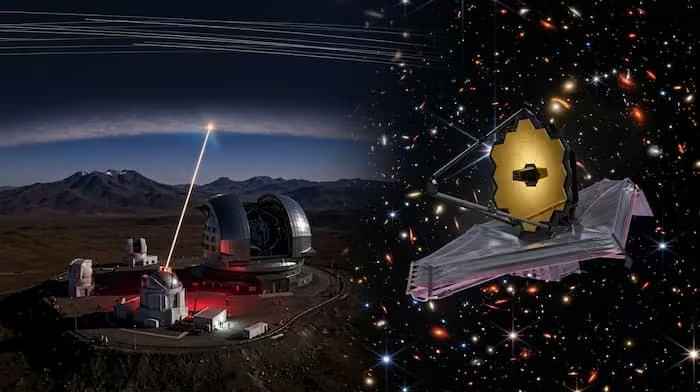
Space-based observatories outperform ground-based telescopes
As we stand at the threshold of this extraordinary new era, humanity is better equipped than ever thanks to Space-Based Observatories to answer some of our most profound questions: How did the universe begin? What is our place within it? And are we alone?
The coming decades promise not only deeper scientific understanding but also a renewed sense of wonder that can inspire generations to come — provided we responsibly safeguard the skies above us for Space-Based Observatories.