
Climate Action & Earth Protection
Part I
The Earth Protection in Science and the Qur’an & Islamic Environmental Stewardship through Science and Technology
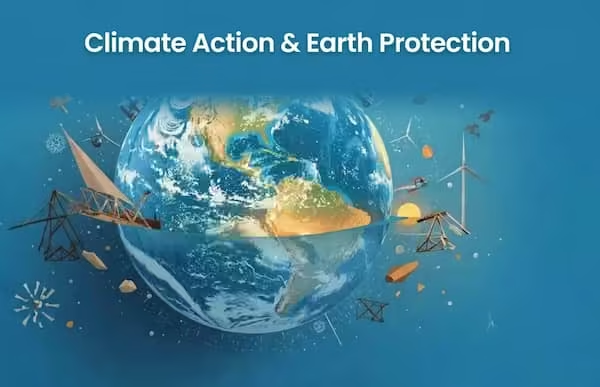
Planet Earth at the heart of global climate action, powered by renewable energy and collective protection efforts.
Introduction: Climate Action & Earth Protection
“I am dying because of human negligence… Embrace me before it is too late.”
Personified in this urgent cry, the Earth stands as a living witness to the accelerating environmental crisis of the twenty-first century. Human-driven climate change now dominates global academic, political, and ethical discourse. Scientific consensus is unequivocal: anthropogenic activities — chiefly the burning of fossil fuels, rampant deforestation, and unchecked industrial emissions — constitute the dominant driver of contemporary climate disruption. Global temperatures have already risen by more than 1.1°C above pre-industrial levels, triggering extreme weather events, accelerated biodiversity collapse, and profound threats to ecological stability, economic systems, and human well-being. The planet is rapidly approaching irreversible tipping points that imperil the very conditions sustaining life.
Yet science and policy alone cannot reverse this trajectory. Ethical and religious worldviews are essential in reorienting humanity’s relationship with creation. Within the Qur’anic worldview, the Earth is not mere property but a balanced, purposeful creation and a sacred trust (amanah). Humanity is appointed as khalifah — vicegerent and steward — upon the earth (Qur’an 6:165; 35:39), charged with preserving its harmony rather than exploiting it. The Qur’an explicitly forbids corruption (fasad) in the land and commands believers to walk upon it gently (25:63), underscoring that environmental stewardship is a moral and spiritual imperative.
This research-based essay critically examines climate action and Earth protection through a truly interdisciplinary lens. It fuses rigorous scientific understanding of the planet’s structure and environmental systems with the Qur’anic ethical framework of stewardship and moral responsibility. In doing so, it demonstrates that sustainable practice is powerfully reinforced by both empirical evidence and divine guidance. Ultimately, the essay argues that meaningful climate action demands far more than technological fixes or regulatory measures; it requires a profound transformation in human values, attitudes, and collective responsibilities toward our fragile planetary home. Only by embracing the Earth — scientifically, ethically, and spiritually — can humanity avert catastrophe and fulfill its sacred duty.
Climate Change: Scientific Foundations and Impacts
Climate change refers to long-term alterations in global temperature patterns, precipitation regimes, and the frequency and intensity of weather extremes. It is primarily driven by the rapid accumulation of greenhouse gases — carbon dioxide (CO₂), methane (CH₄), and nitrous oxide (N₂O) — in the Earth’s atmosphere. These gases, largely emitted through fossil fuel combustion, deforestation, industrial processes, and intensive agriculture, enhance the natural greenhouse effect, trapping heat and causing unprecedented global warming.
Scientific consensus, as affirmed by the IPCC, is unequivocal: human activities have unequivocally caused the warming of the atmosphere, ocean, and land. Global surface temperatures have already risen approximately 1.2–1.5°C above pre-industrial levels, with recent years (2023–2025) ranking among the hottest on record. Human-induced warming continues at a rate of about 0.26°C per decade, pushing the planet perilously close to critical tipping points.
The consequences are widespread, severe, and accelerating. Rising temperatures accelerate the melting of glaciers and polar ice sheets, driving global sea-level rise that now threatens millions in low-lying coastal regions and island nations with inundation, salinization of freshwater, and forced displacement. Altered rainfall patterns — intensified droughts in some areas and extreme flooding in others — severely disrupt agricultural systems, reducing crop yields and heightening the risk of widespread food insecurity. Every additional degree of warming is projected to diminish global food production capacity significantly, with staple crops like wheat, maize, and rice already suffering measurable losses.
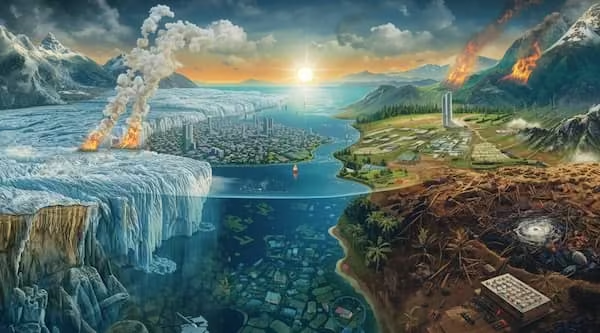
Visual proof of climate change: from smoking icy industrial zones to lush centers and scorched, deforested wastelands.
Extreme weather events have become markedly more frequent and intense: prolonged heatwaves scorch ecosystems and human health, devastating wildfires consume vast landscapes, powerful hurricanes and floods destroy infrastructure, and prolonged droughts trigger humanitarian crises. These events place immense pressure on public health systems, economic stability, emergency services, and biodiversity. Coral reefs bleach, species migrate or face extinction, and entire ecosystems approach irreversible collapse.
In short, climate change is no longer a distant threat but a present-day emergency reshaping planetary systems and human societies. Addressing it demands urgent, transformative action grounded in both scientific reality and ethical responsibility.
Earth Protection
➤ How Can We Protect the Earth and Strengthen Resource Management?
Earth protection extends far beyond climate mitigation alone. It demands the active preservation of ecosystems, biodiversity, and finite natural resources. The planet operates as a highly interconnected system where disruption in one component can trigger cascading effects across the globe. Forests act as vital carbon sinks and regulators of the water cycle, oceans absorb vast amounts of carbon dioxide and excess heat, and rich biodiversity underpins the resilience of entire ecosystems.
Unsustainable human exploitation has severely disrupted these delicate balances. Rampant deforestation drives habitat destruction, biodiversity loss, and increased atmospheric carbon. Overfishing collapses marine food chains, while widespread pollution of air, water, and soil degrades environmental quality and threatens human health. Scientific evidence strongly supports the urgent shift toward sustainable resource management practices. These include large-scale transitions to renewable energy, robust conservation and reforestation programs, protected area expansion, and the adoption of circular economic models that prioritize reduce, reuse, and recycle principles to minimize waste and resource depletion.
Effective Earth protection also requires addressing the profound social dimension of the crisis. Climate change and environmental degradation disproportionately affect vulnerable populations, particularly in developing countries that possess the least resources to adapt. This reality frames environmental protection not merely as an ecological necessity but as a pressing issue of social justice, equity, and human rights.
Ultimately, protecting the Earth and strengthening resource management demands integrated strategies that combine scientific innovation, policy enforcement, community participation, and ethical commitment. Only through responsible stewardship can we restore planetary health and secure a sustainable future for all generations.
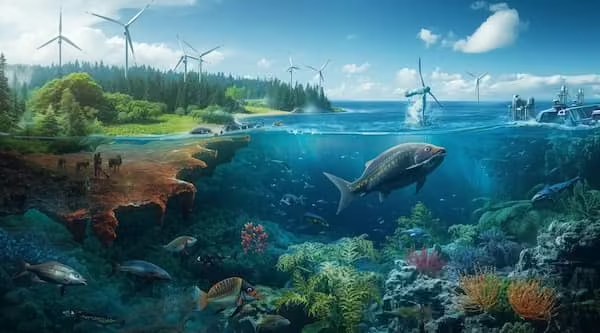
A harmonious vision of earth protection — renewable wind energy on land and thriving marine life below the surface.
Structure of the Earth
Integration of Science and Faith
Scientific research provides empirical evidence of environmental change and guidance for mitigation and adaptation strategies, revealing the fragility of Earth’s interconnected systems — from atmospheric greenhouse gas dynamics to the geological layers that sustain life. Qur’anic ethics complement this by offering profound moral motivation and a value-based framework that encourages responsible behaviour, stewardship, and restraint.
The Qur’an portrays humans as khalifah (stewards or vicegerents) on Earth, entrusted with the responsibility to care for creation rather than exploit it destructively. For instance, in Surah Al-Baqarah (2:30), Allah announces the appointment of humanity as successors on Earth, emphasizing accountability for how this trust is managed.
Today, our gravest concern is the unceasing desecration of the planet — driven by collective folly, deep-rooted ignorance, rampant corruption, and boundless greed. We remain dangerously unaware of how these relentless actions are propelling Earth toward its own death, an irreversible collapse from which recovery may prove impossible.
Consider these profound inversions of virtue, where what is sacred and lawful is twisted into its opposite:
- Man, created as a steward of goodness, becomes the embodiment of vice — indeed, Satan himself in his destructive arrogance.
- Moderation, the path of balance and harmony, dissolves into utter chaos.
- The guardian, meant to protect and nurture, degenerates into a merciless bully.
- Uswa Hasana (أسوة حسنة) — the beautiful exemplar, the perfect model of conduct — is degraded into quarrelsome discord and strife.
Reflect deeply: Are we not, through these very betrayals of moral and spiritual law, steering ourselves straight toward annihilation? Our planet’s fragile layers — its life-giving crust, its restless mantle, its protective magnetic core — already bear the deep scars of this hubris. They cry out for us to awaken to wisdom before it is too late. The time for repentance and restoration is now.
“Heal me, ocean guardian, so we can rise together in harmony before the tides turn against us.”
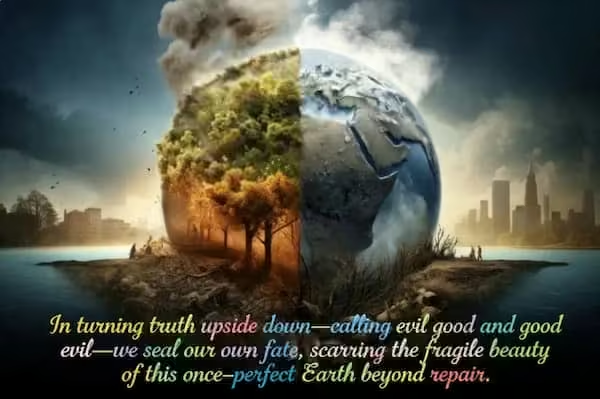
The divided structure of Earth — vibrant life versus scarred destruction — reveals the urgent need for science and faith to work together.
Reflect deeply: Are we not, through these very betrayals of moral and spiritual law, steering ourselves straight toward annihilation? Our planet’s fragile layers — its life-giving crust, its restless mantle, its protective magnetic core — already bear the deep scars of this hubris. They cry out for us to awaken to wisdom before it is too late. The time for repentance and restoration is now.
“I am choking on your waste… heal my depths, so the ocean can thrive again.”
From a Qur’anic standpoint, harming the Earth undermines the divine trust (amanah) placed in humanity, while protecting it aligns with justice, compassion, and accountability to Allah and future generations.
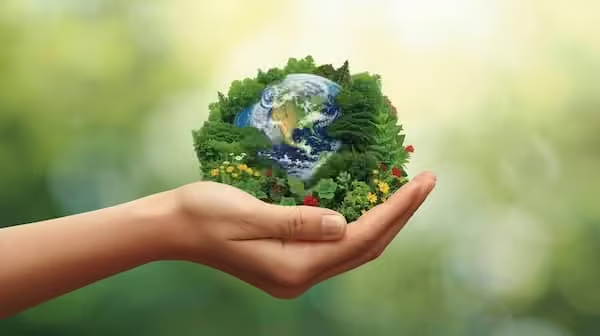
A caring hand holds our living Earth — a beautiful symbol of protecting the planet through the integration of science and faith.
Conclusion
The accelerating environmental crisis of the twenty-first century demands more than technological solutions or policy reforms. It calls for a profound transformation in human values, attitudes, and responsibilities toward the Earth. Scientific evidence has clearly revealed the fragility of our planet’s interconnected systems and the urgent need for sustainable resource management, while the Qur’anic ethical framework provides powerful moral motivation through the concepts of khalifah (stewardship) and amanah (divine trust).
By integrating empirical knowledge with faith-based responsibility, humanity can move beyond exploitation toward genuine guardianship. Embracing the Earth — scientifically, ethically, and spiritually — is no longer optional; it is an existential imperative. Only through collective repentance, restraint, and restorative action can we heal the scars of hubris, fulfil our sacred duty as vicegerents on Earth, and secure a just and sustainable future for all generations. The time to embrace our planet is now — before it is too late.
فَبِأَىِّ ءَالَآءِ رَبِّكُمَا تُكَذِّبَانِ
So which of the favors of your Lord would you deny?