
NASA BLUE MARBLE
Earth from the Depths of Space
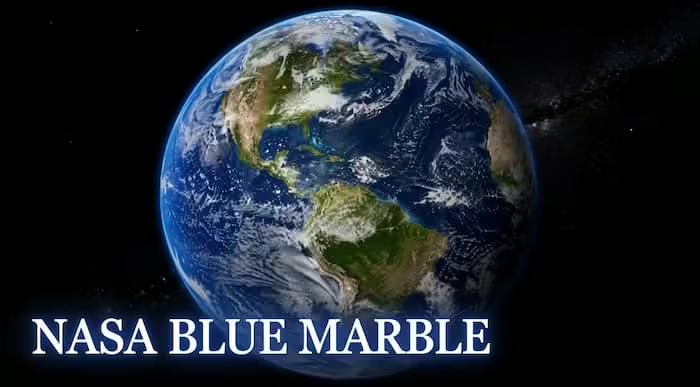
NASA Blue Marble — the iconic high-resolution view of Earth from space.
NASA Blue Marble: Earth from Space stands as one of humanity’s most iconic and moving symbols — a timeless collection of breathtaking true-color images portraying our planet as a luminous, delicate blue orb floating alone in the infinite void. These views strip away all borders and boundaries, revealing only one shared, interconnected world where all life coexists in fragile harmony.
Far beyond mere pictures, they evoke profound wonder, humility, and a powerful call to stewardship. As of January 2026, the Blue Marble legacy continues to inspire through historical and ongoing satellite imagery, with NASA’s cutting-edge Earth-observation technologies (including archival daily views from DSCOVR/EPIC) and bold new frontiers advanced by programs like Artemis. While the DSCOVR satellite’s EPIC camera faced a software anomaly in July 2025 and remains offline for some functions, the mission’s contributions live on in the archive, with the latest available full-disk true-color images dated from December 2025. Preparations for successor missions ensure this vital perspective endures.
The Blue Marble reminds us that our small, precious planet is irreplaceable — a single fragile home deserving of protection for all future generations.
Understanding NASA: The Driving Force Behind the Vision
NASA Blue Marble – the iconic series of Earth images from space – is a perfect example of how NASA’s core mission, established on October 1, 1958, amid the Cold War space race, continues to inspire and benefit humanity today. Founded with the drive for exploration, scientific discovery, and practical benefits for all people, NASA’s enduring motto — “For the Benefit of All” — powers everything from boundary-pushing space missions to innovations that improve life on Earth. The agency excels in human spaceflight, solar system exploration, Earth observation, and astrophysics. It manages the International Space Station (which marked over 25 years of continuous human presence by 2025), deploys advanced Mars rovers, and operates satellite networks that track climate change and environmental shifts.
These remarkable efforts not only expand our understanding of the cosmos but also deliver tangible, real-world advancements — from more accurate weather forecasting and medical technologies to environmental monitoring tools — that positively impact billions of lives worldwide. In this context, NASA Blue Marble represents one of the most powerful outcomes of NASA’s Earth observation work: stunning, true-color views of our planet that remind us of its fragility, unity, and beauty, while reinforcing the agency’s commitment to benefiting all of humankind.
The Legendary 1972 Blue Marble: A Defining Moment
The NASA Blue Marble story began on December 7, 1972, during Apollo 17 — NASA’s final crewed mission to the Moon. As the spacecraft traveled away from Earth, the crew captured a spontaneous photograph from about 29,000 kilometers (18,000 miles) away. With the Sun perfectly positioned behind them, the entire sunlit side of the planet appeared fully illuminated in vivid, natural color for the very first time.
This historic 1972 NASA Blue Marble image reveals vast, deep-blue oceans filling most of the frame, intricate patterns of swirling white clouds, the bold outline of the African continent and the Arabian Peninsula, and the bright gleam of the Antarctic ice cap at the bottom. For the first time in history, humanity saw Earth as a single, unified, borderless sphere floating in the endless blackness of space — a fragile and beautiful whole without any divisions.
Here are powerful views of the original Apollo 17 NASA Blue Marble, the photograph that forever transformed how we perceive our home planet.

The legendary 1972 Blue Marble — a defining moment that forever changed how we see our planet.

A classic brass compass rose resting on a detailed antique map — a timeless symbol of exploration and navigation.
The 1972 NASA Blue Marble photograph, released during the emerging environmental awakening of the 1970s, quickly became a global emblem that transformed public perception forever. This single image dramatically underscored the delicate thinness of Earth’s atmosphere — a fragile, wafer-thin layer protecting all life — and helped galvanize the modern conservation movement. It played a key role in inspiring the first Earth Day in 1970 (and its growing momentum through the decade), fueling widespread environmental activism, and laying the foundation for today’s climate consciousness and global sustainability efforts. The NASA Blue Marble from Apollo 17 remains one of the most powerful symbols of planetary unity and vulnerability, reminding generations that we share one small, irreplaceable home in the vastness of space.
The Overview Effect: A Transformative Realization
Seeing Earth from great distance frequently evokes the “Overview Effect” — a profound cognitive and emotional shift that astronauts describe as intense awe, deep unity, and an acute awareness of our planet’s fragility. This transformative realization is powerfully embodied in the NASA Blue Marble, the iconic series of true-color images that have allowed millions to share, at least visually, the same perspective once reserved for a privileged few.
Apollo 8’s Bill Anders captured the essence of this experience with unforgettable clarity: “We came all this way to explore the Moon, and the most important thing is that we discovered the Earth.” His words, spoken after the crew’s historic 1968 journey, resonate even more strongly when viewed alongside the NASA Blue Marble photographs that followed — especially the legendary 1972 Apollo 17 image and the continuous modern views delivered by satellites today.
Contemporary astronauts aboard the International Space Station continue to echo this sentiment. They speak of Earth’s slender blue atmospheric veil, the absence of borders, and the sudden recognition that all life shares one vulnerable home. The NASA Blue Marble makes this realization accessible to everyone, turning a rare astronaut insight into a shared global vision.
In an era of environmental challenge, the Overview Effect — illuminated so vividly by the NASA Blue Marble — continues to inspire humility, interconnectedness, and a renewed sense of responsibility for the only world we have.
Here are timeless astronaut views that embody the Overview Effect

The Overview Effect — a transformative realization that changes how we see our planet and ourselves.
Modern Blue Marble: From Composites to Daily Reality
NASA has evolved the Nasa Blue Marble concept using satellite data. The Blue Marble: Next Generation series, built from MODIS observations on the Terra and Aqua satellites (primarily from 2004 data), offers high-resolution (500 metres per pixel), cloud-free monthly composites. These reveal seasonal transformations — greening forests, advancing snow, shifting vegetation — providing scientists with clear, accurate global views for climate studies and environmental monitoring.
Here are stunning examples of Blue Marble: Next Generation monthly views, showcasing Earth’s dynamic beauty

Modern Blue Marble — from early composites to the daily reality of high-resolution Earth imagery.

Modern Blue Marble — from early composites to the daily reality of high-resolution Earth imagery from space.
NASA Blue Marble: Today, the Deep Space Climate Observatory (DSCOVR) satellite — a landmark collaboration between NASA and the National Oceanic and Atmospheric Administration (NOAA) — continues one of humanity’s most profound ongoing visual conversations with our home planet. Stationed nearly 1.5 million kilometers away at the Earth-Sun Lagrange Point 1 (L1), DSCOVR maintains a unique, continuous vantage point that allows it to observe the fully illuminated face of Earth without interruption from orbital night.
Its primary Earth-facing instrument, the Earth Polychromatic Imaging Camera (EPIC), delivers spectacular daily full-disk true-color images that have become the modern embodiment of the Blue Marble tradition. These near-real-time views capture the planet’s swirling clouds, deep blue oceans, and delicate atmospheric limb with remarkable clarity, offering both scientific data and a powerful emotional reminder of Earth’s singularity.
Following a software bus anomaly in July 2026, the spacecraft experienced a temporary interruption in operations. Thanks to dedicated recovery efforts by NASA, NOAA, and international partners, DSCOVR returned to full functionality later that year. It has since resumed its vital contributions, supplying continuous climate monitoring, ozone measurements, aerosol data, cloud properties, and the near-real-time Earth perspectives that keep the Blue Marble legacy alive and vibrant.
In an age of rapid environmental change, DSCOVR’s restored gaze ensures that the iconic image of our fragile, borderless world remains not a historical artifact, but a living, daily testament — urging continued stewardship of the only home we have ever known.
NASA’s Broader Impact: Benefits, Innovations, and Challenges
NASA’s work goes well beyond stunning visuals. Its Earth-monitoring satellites aid disaster response, optimize farming practices, and shape international climate strategies. Economically, NASA investments deliver strong returns via employment, tech breakthroughs, and industry advancement.
The 2025 NASA Spinoff report highlights over 40 technologies transferred to industry, such as:
- AI-driven quality control for manufacturing lines (evolved from Mars rover navigation AI)
- Advanced 3D printing methods developed for lunar construction, now applied to Earth buildings
- Next-generation batteries enhancing renewable energy storage
These breakthroughs improve healthcare (e.g., portable diagnostics), boost transportation safety, and strengthen environmental tracking — proving space exploration’s direct value to daily life.
Challenges endure: limited funding, engineering risks, international dynamics, and sustainability demands. NASA responds with smart collaborations, operational improvements, and active public involvement.
A Powerful Conclusion: One Fragile World Worth Protecting
NASA’s “Nasa Blue Marble: Earth from Space” transcends photography and data — it remains a timeless emblem of our singular home. From the revolutionary 1972 image that ignited environmental awareness, through today’s routine satellite imagery, to the upcoming Artemis II mission (with launch window opening no earlier than February 5, 2026, for the first crewed lunar flyby in over 50 years), NASA Blue Marble: continues unveiling Earth’s delicate splendor while urging us to protect it.
Amid climate change, resource pressures, and worldwide issues, the Nasa Blue Marble delivers a clear message: in the immense cosmos, our world is a tiny, precious, irreplaceable blue dot — the sole haven for all life, aspirations, and dreams.
NASA’s greatest legacy extends beyond the stars; it resides in our collective commitment to safeguarding this exquisite, vulnerable home for generations yet to come.