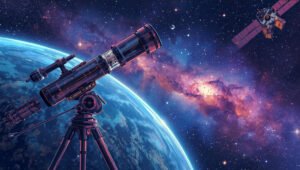
Space Discoveries and Technology: How Modern Tools Are Transforming Astronomy (Part 1)
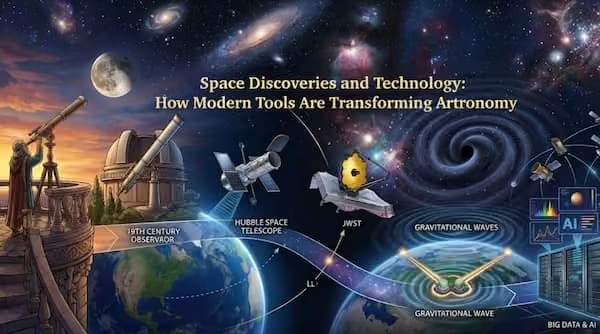
Evolution of cosmic observation from 19th century telescopes to JWST, gravitational waves, and AI-powered astronomy.
Introduction
Humanity’s quest to understand the universe stretches across millennia — from ancient civilizations mapping constellations with the naked eye to today’s advanced space observatories probing the cosmos’s deepest secrets. Each technological leap has dramatically expanded our cosmic perspective, revealing a universe far more vast, dynamic, and mysterious than previously imagined.
In recent decades, this progress has accelerated at an unprecedented pace. Sophisticated ground- and space-based telescopes, orbiting observatories, satellites, and artificial intelligence have transformed the field of astronomy. These innovations have allowed us to witness distant galaxies forming in the early universe, observe newborn stars emerging from dense cosmic dust, and detect the first signs of atmospheres on distant exoplanets. They have also revolutionized how vast amounts of cosmic data are collected, processed, and interpreted — turning raw signals into deep insights about black holes, dark energy, galaxy evolution, and the potential origins of life.
This article explores these remarkable advancements, focusing on the transformative role of space telescopes and the extraordinary discoveries made by the James Webb Space Telescope (JWST), humanity’s most powerful observatory to date.
How Space Telescopes Revolutionized Our Cosmic View
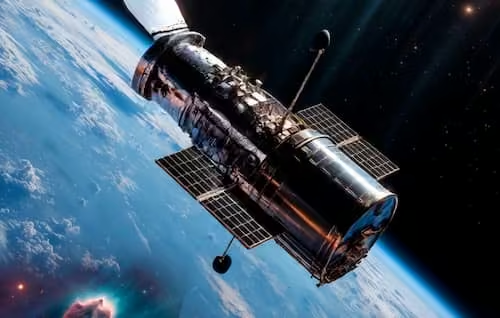
The legendary Hubble Space Telescope orbits our planet, its solar panels catching the sunlight as it continues to explore the wonders of the universe.
Space telescopes are sophisticated instruments placed beyond Earth’s atmosphere, allowing astronomers to observe the universe free from the blurring effects of air turbulence, weather, and light pollution. While ground-based telescopes have delivered impressive results, they struggle with atmospheric distortion that smears fine details and blocks or absorbs critical wavelengths such as ultraviolet, infrared, and X-rays. By operating in the vacuum of space, these observatories capture sharper, deeper, and more complete views across the electromagnetic spectrum.
The Hubble Space Telescope, launched on April 24, 1990, marked a historic turning point. Now well into its 36th year of operation as of 2026 — and still delivering groundbreaking science after multiple servicing missions — Hubble transformed astronomy with its unprecedented clarity and versatility. Equipped with a 2.4-meter mirror and instruments covering ultraviolet, visible, and near-infrared light, it has produced some of the most iconic and scientifically valuable images ever taken.
Hubble’s sharp observations revealed stunning details of celestial objects previously hidden or blurred from Earth. It captured glowing nebulae where stars are born, dense star clusters, and the violent aftermath of exploding stars (supernovae). Its long-exposure Deep Field images unveiled thousands of faint, distant galaxies in seemingly empty patches of sky, offering a window into the universe’s early history.
Key scientific breakthroughs include:
- Precise measurement of the universe’s expansion rate (the Hubble constant) using Cepheid variable stars and Type Ia supernovae, helping refine our understanding of cosmic evolution and contributing to the discovery of dark energy.
- Direct evidence of galaxy evolution over billions of years, showing how galaxies grow, merge, and change shape.
- Detailed insights into stellar life cycles, from birth in dusty nurseries to dramatic deaths that seed the cosmos with heavy elements.
- Confirmation that supermassive black holes reside at the centers of most galaxies and play a crucial role in their development.
- Early studies of exoplanet atmospheres and solar system phenomena, from comet impacts on Jupiter to dynamic changes on distant planets.
These achievements elevated astronomy from largely descriptive observations to a rigorous, quantitative science. Researchers could now test and refine theories about dark matter — the invisible framework shaping galaxies — and the mysterious force of dark energy driving the universe’s accelerating expansion.
Hubble’s enduring legacy proved the immense value of placing telescopes above the atmosphere. It not only delivered clearer, fuller pictures of the cosmos but also paved the way for more advanced successors, fundamentally reshaping humanity’s understanding of our place in the universe.
The James Webb Space Telescope: Peering into Cosmic Dawn
Launched on December 25, 2021, and fully operational by mid-2022 — with major scientific campaigns delivering transformative results through 2025 and into 2026 — the James Webb Space Telescope (JWST) stands as the most powerful and sophisticated space observatory ever constructed. Designed primarily to observe in infrared wavelengths, JWST can pierce through dense cosmic dust clouds that completely obscure visible-light telescopes and detect the faint, redshifted heat signatures from the universe’s earliest stars, galaxies, and planetary systems — objects that remained invisible to previous instruments like Hubble.
Positioned at the second Sun-Earth Lagrange point (L2), approximately 1.5 million kilometers from Earth, JWST operates in a stable, cold environment far from our planet’s heat and light interference. Its massive 6.5-meter segmented primary mirror, composed of 18 gold-coated beryllium hexagons, collects far more light than any previous space telescope. A five-layer, tennis-court-sized sunshield keeps the observatory at cryogenic temperatures near –223°C, enabling its ultra-sensitive infrared instruments to function at peak performance.
Engineering Marvel at L2
This strategic location and advanced cooling system allow JWST to achieve unprecedented sensitivity across near- and mid-infrared wavelengths. By capturing redshifted light from the most distant objects, the telescope effectively looks back in time to the first few hundred million years after the Big Bang, revealing eras that were previously hidden from view.
Transformative Discoveries
By 2025, JWST had already produced a series of groundbreaking findings that profoundly reshaped cosmology and astrophysics:
- The earliest supernova yet observed, which exploded just 730 million years after the Big Bang, providing a rare direct window into the deaths of the first massive stars in the infant universe.
- Strongest evidence to date of thick atmospheres on rocky exoplanets, including the broiling lava world TOI-561 b — a super-Earth featuring a global magma ocean and a volatile-rich atmosphere potentially containing silicate vapors.
- Dramatic detections of escaping helium tails streaming from “puffy” hot Jupiters such as WASP-121b and WASP-107b, revealing intense atmospheric loss processes driven by extreme stellar radiation on close-in gas giants.
- Direct hints of “monster stars” — primordial stars with masses between 1,000 and 10,000 times that of the Sun — that may have fueled the rapid growth of the first supermassive black holes in the young universe.
- The discovery of unexpectedly mature spiral galaxies and hundreds of unusually bright early galaxies that appear far more developed than current models predicted, challenging long-held timelines of star and galaxy formation.
Rewriting Cosmic History
JWST is doing far more than refining existing theories — it is revealing entirely hidden chapters of cosmic evolution. Its observations are forcing astronomers worldwide to revise fundamental models of how the first stars ignited, how planets formed, how galaxies assembled, and how the conditions for life might arise elsewhere. By unveiling the infrared universe in stunning detail, JWST continues to push the boundaries of human knowledge, offering tantalizing clues about our own cosmic origins and the potential for habitable worlds across the galaxy.
Peering into the Cosmic Dawn: JWST’s Groundbreaking Revelations from the Early Universe
The James Webb Space Telescope has opened an unprecedented window into the universe’s first billion years — an era previously shrouded in mystery and largely inaccessible to earlier observatories. By capturing infrared light that has traveled for more than 13 billion years, JWST is effectively allowing scientists to witness the cosmic dawn: the moment when the first stars and galaxies ignited, ending the cosmic Dark Ages and transforming the universe from a cold, neutral haze into the complex, structured cosmos we see today.
Operating from its stable perch at the Sun-Earth L2 point, JWST’s infrared instruments are uniquely suited to detect the faint, redshifted glow of these primordial objects. Its massive 6.5-meter mirror and ultra-cold detectors have revealed galaxies that formed far earlier and far more rapidly than any theoretical model had predicted. These “impossibly early” galaxies appear as bright, compact structures already rich in heavy elements just a few hundred million years after the Big Bang — a finding that has sent shockwaves through cosmology.
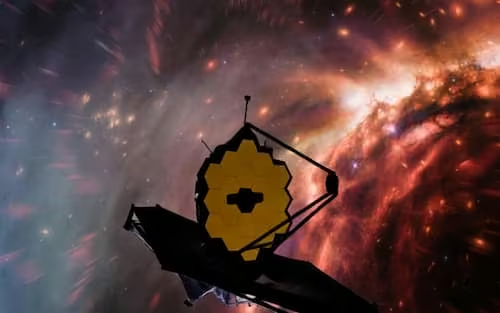
Key discoveries include:
- Hundreds of luminous galaxies at redshifts greater than 10 (corresponding to less than 500 million years after the Big Bang), some already forming mature spiral arms and showing signs of organized structure far sooner than expected.
- Direct evidence of the epoch of reionization, when ultraviolet light from the first stars and galaxies stripped electrons from hydrogen atoms, clearing the fog that had obscured the early universe.
- Observations of “monster stars” — hypothetical Population III stars with masses thousands of times that of the Sun — whose explosive deaths may have seeded the first black holes and triggered rapid galaxy growth.
- The earliest confirmed supernova, detonating just 730 million years after the Big Bang, offering a rare glimpse into the violent deaths of the universe’s very first stellar generations.
- Unexpected chemical signatures in these infant galaxies, including surprisingly high levels of oxygen and carbon, suggesting that heavy-element enrichment occurred much faster than previously thought.
These findings are forcing astronomers to rethink fundamental models of cosmic evolution. Traditional theories assumed that galaxy formation was a gradual process taking billions of years. JWST data instead suggest a far more dynamic, accelerated timeline in which massive star clusters and supermassive black holes grew almost simultaneously in the universe’s infancy. The telescope’s deep-field images have also revealed thousands of previously invisible faint galaxies, dramatically increasing estimates of the total number of galaxies in the observable universe.
Beyond pure discovery, these observations carry profound philosophical weight. By revealing how quickly the universe transitioned from simplicity to complexity, JWST is helping answer one of humanity’s oldest questions: how did the conditions for stars, planets, and ultimately life arise so early in cosmic history? Its data are now being integrated into next-generation simulations that incorporate new physics, such as enhanced dark matter interactions or rapid black-hole seeding mechanisms.
As JWST continues its mission well into the 2030s, it is not merely refining our timeline of the universe — it is rewriting the opening chapter of cosmic history itself. The telescope’s revelations from the cosmic dawn are reshaping textbooks, inspiring new theoretical frameworks, and reminding us that the universe still holds surprises far beyond our most ambitious predictions.
Hunting for Habitable Worlds: JWST’s Transformative Role in Exoplanet Science and the Search for Life
While JWST’s contributions to cosmology are revolutionary, its impact on exoplanet research may ultimately prove even more profound for humanity’s place in the cosmos. For the first time, astronomers can directly analyze the atmospheres of distant worlds, searching for the chemical fingerprints of habitability and even potential biosignatures — molecules that could indicate the presence of life.
Specializing in infrared wavelengths, JWST can detect subtle heat signatures and molecular absorption lines that are invisible to visible-light telescopes. Its transit spectroscopy technique — observing how starlight filters through a planet’s atmosphere during a transit — has delivered unprecedented detail, revealing everything from temperature profiles to atmospheric composition on planets ranging from scorching hot Jupiters to temperate rocky worlds.
Standout achievements by 2026 include:
- Detection of thick, volatile-rich atmospheres around rocky super-Earths such as TOI-561 b, where silicate vapors and a global magma ocean suggest extreme volcanic activity that could influence surface conditions.
- Detailed atmospheric profiles of “puffy” hot Jupiters like WASP-121b and WASP-107b, showing dramatic helium escape tails driven by intense stellar radiation — offering clues about how atmospheres evolve on close-in planets.
- The first robust evidence of carbon dioxide, water vapor, and potential sulfur compounds in the atmospheres of sub-Neptune and terrestrial planets, narrowing the search for worlds that might retain liquid water.
- High-precision transmission spectra of TRAPPIST-1 system planets, revealing possible haze layers and atmospheric dynamics on multiple rocky worlds orbiting a nearby ultra-cool dwarf star — one of the most promising nearby systems for habitability.
- Early hints of dimethyl sulfide (a potential biosignature produced by marine phytoplankton on Earth) in select temperate exoplanet atmospheres, though these require further confirmation.
These observations mark a shift from merely detecting exoplanets to truly characterizing them. JWST has moved the field from counting worlds to understanding their climates, geology, and potential for life. Its data are helping astronomers distinguish between lifeless “lava worlds,” hydrogen-rich mini-Neptunes, and potentially Earth-like rocky planets with protective atmospheres and stable surface conditions.
The implications extend far beyond science. By identifying which distant worlds might harbor liquid water, organic chemistry, or even microbial life, JWST is providing the first empirical data to address the question of whether we are alone in the universe. Its findings are guiding the design of future missions, such as the Nancy Grace Roman Space Telescope and proposed infrared interferometers, that will directly image Earth-like planets around Sun-like stars.
Moreover, JWST’s work is inspiring interdisciplinary collaboration between astronomers, planetary scientists, and astrobiologists. Sophisticated atmospheric models now incorporate JWST spectra to predict surface conditions, cloud chemistry, and even potential biosignature false positives — ensuring that any future detection of life is robust and credible.
In essence, JWST is not just observing distant planets — it is bringing them into focus as real, three-dimensional worlds with weather, chemistry, and possibly biology. As it continues to scan hundreds of exoplanet targets, the telescope is laying the groundwork for the next great chapter in humanity’s cosmic journey: the potential discovery of life beyond Earth.