
The Emergence of the Hanif: Prophet Ibrahim عليه السلام in the City of Idols
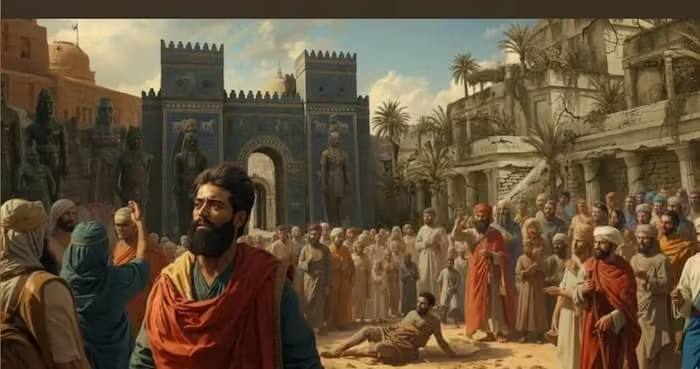
Prophet Ibrahim عليه السلام emerges as the Hanif in the city of idols, calling the people away from idolatry.
Introduction: The Emergence of the Hanif: Prophet Ibrahim عليه السلام in the City of Idols
The story of Prophet Ibrahim عليه السلام occupies a foundational place in the religious and intellectual history of monotheism. His life embodies the transition from inherited ritualism to conscious faith grounded in observation, reason, and divine guidance. The Emergence of the Hanif begins in this early phase of his mission.
This chapter examines the early phase of Ibrahim’s عليه السلام mission, set against the backdrop of ancient Babylon—an environment characterised by entrenched idolatry, political absolutism, and widespread spiritual disorientation. Through this narrative, we highlight the development of Ibrahim’s عليه السلام monotheistic consciousness and the formative moments that shaped his role as a prophet عليه السلام and reformer.
The Emergence of the Hanif stands as one of the most transformative events in the history of faith. In the City of Idols, where polytheism and idolatry had reached their peak, Prophet Ibrahim عليه السلام introduced the pure light of monotheism to a world drowning in falsehood.
The Emergence of the Hanif was not accidental. It was a deliberate divine intervention to revive the original upright religion of humanity. Prophet Ibrahim عليه السلام, the quintessential Hanif, rejected every form of idolatry that saturated Babylon and called humanity back to the worship of Allah alone.
This marked the beginning of a spiritual revolution whose impact continues to shape billions of lives today. The Emergence of the Hanif carries profound lessons for every generation. In Babylon, society had normalised the worship of stone, wood, stars, and powerful rulers.
Yet it was precisely here, amid the densest concentration of idolatry, that Prophet Ibrahim عليه السلام emerged as the one who would redefine faith through reason and revelation. The Emergence of the Hanif proved that no environment, however steeped in idolatry and spiritual disorientation, can prevent the rise of pure monotheism when Allah chooses a servant for guidance.
Prophet Ibrahim عليه السلام’s stand became the archetype of courageous monotheism that later prophets and believers would emulate. The significance of The Emergence of the Hanif extends across religious traditions. Jews, Christians, and Muslims all trace their monotheistic roots to Prophet Ibrahim عليه السلام.
In Islamic teaching, he is specifically honoured as the Hanif—the upright one who submitted exclusively to Allah without the later distortions that affected other communities. His early life in this environment of entrenched idolatry demonstrates that true faith begins with personal reflection, not inherited ritual.
Even today, the story inspires believers facing modern forms of idolatry—whether materialism, nationalism, or ego worship. Prophet Ibrahim عليه السلام’s example teaches that one person’s unwavering commitment to monotheism can challenge entire systems of falsehood. The Emergence of the Hanif remains a timeless call to examine our own beliefs, reject every trace of shirk, and embrace the pure monotheism that Prophet Ibrahim عليه السلام embodied from his earliest years.
Babylon: A Landscape of Idolatry and Power ⚔️
In ancient Babylon, religious life was dominated by a vast pantheon of deities. These gods were represented in monumental temples and in the daily ritual practices of its people. The city’s ziggurats stood as visible symbols of a complex, polytheistic religious order, while the royal palace reinforced the authority of a ruler who demanded both political and divine allegiance.
Nimrod, the autocratic king, publicly claimed godhood, further blurring the lines between governance and theological control. Idols of stone and wood populated the city’s streets and sanctuaries. These objects, devoid of consciousness or agency, were nonetheless treated as intermediaries of power.
In this environment of spiritual confusion and symbolic excess, The Emergence of the Hanif represented not only a religious challenge but a direct confrontation with the ideological foundation of the state.
Babylon, the City of Idols, was a metropolis where idolatry permeated every layer of existence. Massive ziggurats rose toward the heavens, dedicated to chief deities such as Marduk, Ishtar, and Bel. These towering structures were not merely places of worship; they were centres of political power, astronomical observation, and economic control.
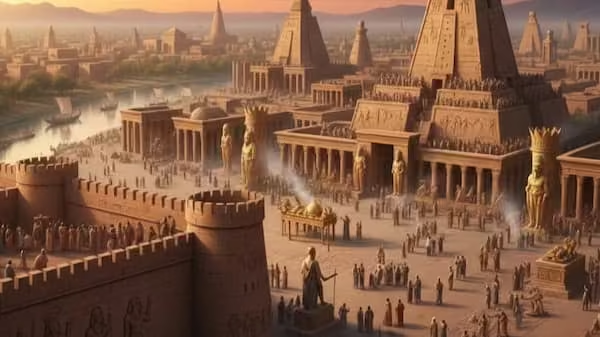
Babylon at its peak: a sweeping landscape of idolatry, monumental power, and pagan grandeur.
The people participated in elaborate festivals, processions, and sacrifices, believing that their prosperity and safety depended on appeasing these man-made gods. Idolatry in Babylon was both a spiritual and a civic duty, enforced by priests and the royal court alike. The Emergence of the Hanif stood in complete opposition to this system.
King Nimrod’s claim to divinity intensified the atmosphere of idolatry and absolutism. By positioning himself as a living god or the supreme representative of the pantheon, Nimrod fused political tyranny with religious idolatry. Dissent against the gods became treason against the throne.
In this landscape of idolatry and power, The Emergence of the Hanif posed an existential threat to the entire system. Prophet Ibrahim عليه السلام’s pure monotheism directly challenged both the theological claims of the priests and the political authority of Nimrod.
Daily life in the City of Idols revolved around idols. Homes contained household shrines. Marketplaces sold carved figures for every occasion. Craftsmen like Azar earned their livelihood by producing these objects of worship. The city was saturated with symbolic excess—statues in streets, temples on every corner, and rituals that consumed time, resources, and spiritual energy.
Yet these idols possessed no power to benefit or harm. They could neither hear supplications nor alter destinies. This profound spiritual disorientation created the perfect backdrop for The Emergence of the Hanif.
The political structure of Babylon reinforced idolatry at every level. Priests and rulers collaborated to maintain the population in a state of fear and conformity. Questioning the gods or the king invited severe punishment. Independent spiritual inquiry was rare and dangerous.
It was precisely in this oppressive environment of entrenched idolatry and concentrated power that The Emergence of the Hanif occurred. His monotheistic consciousness did not develop in a vacuum; it emerged as a direct response to, and rejection of, the idolatry that defined Babylon.
The ziggurats themselves symbolised humanity’s misguided attempt to bridge the gap between earth and heaven through human effort and polytheistic religion. For the people of the City of Idols, these monuments represented the pinnacle of civilisation and piety. For Prophet Ibrahim عليه السلام, however, true connection with the Divine came not through climbing man-made towers or worshipping created beings, but through humble submission to the Creator of the heavens and the earth.
In this landscape of idolatry and power, the stand of Prophet Ibrahim عليه السلام was extraordinarily courageous. The Emergence of the Hanif was like a single flame of truth igniting in the heart of darkness. Prophet Ibrahim عليه السلام’s monotheism was not a private conviction; it was a public declaration that would eventually bring him into direct conflict with Nimrod and the entire idolatrous order of the City of Idols.
The Disposition of the Young Ibrahim عليه السلام: the character, nature, mindset, inner qualities, and spiritual inclination 🤲
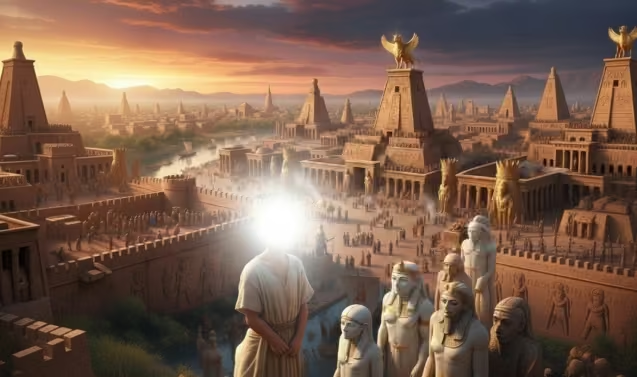
Teenage Ibrahim عليه السلام questioning idols in Babylonian temple!
From his earliest years, Prophet Ibrahim عليه السلام exhibited a natural inclination toward truth. His moral and intellectual clarity set him apart from his surroundings. His father, Azar, was a craftsman of idols—an occupation that brought Ibrahim face-to-face with the contradictions of his society.
The sight of his father shaping a figure with his own hands prompted fundamental questions: How could an object created by humans be worthy of worship? What power could such an artefact possess? Such reflections marked the beginning of The Emergence of the Hanif.
Unlike his contemporaries, he refused to suspend his critical faculties in matters of faith. His search for truth unfolded not through inherited custom but through a process of observation, reflection, and ultimately, divine revelation.
The character of young Prophet Ibrahim عليه السلام was defined by an extraordinary purity of heart and an uncompromising love for truth. Growing up in the City of Idols, where idolatry was the unquestioned norm, his nature instinctively recoiled from the falsehoods he witnessed daily. The Emergence of the Hanif began with this inner rejection of falsehood.
Azar’s profession as an idol-maker placed him in direct contact with the manufacturing of objects that the people of Babylon worshipped as gods. This intimate exposure allowed him to see what others ignored: these were lifeless creations of human hands, incapable of hearing, seeing, or acting. His character would not permit him to participate in the collective delusion of the City of Idols.
Prophet Ibrahim عليه السلام’s mindset was remarkably analytical and courageous for his age. While the children of Babylon absorbed the idolatrous culture around them, he questioned its foundations. Why should anyone bow before a statue his own father had carved? Why attribute divine power to something that could be destroyed by a single blow? These questions were the first stirrings of The Emergence of the Hanif.
His intellectual integrity and refusal to accept inherited falsehoods marked him as fundamentally different from his society. The inner qualities of Prophet Ibrahim عليه السلام included profound wisdom, patience, compassion, and unshakeable resolve. He possessed a spiritual inclination that oriented his entire being toward the worship of the One unseen Creator rather than the visible but powerless idols of Babylon.
This spiritual inclination was not taught to him by priests or family; it was an innate disposition that Allah nurtured within him. In the midst of the City of Idols’ spiritual disorientation, his heart yearned for the truth that would later define the path of pure monotheism.
As he matured, Prophet Ibrahim عليه السلام’s observations expanded beyond household idols to the celestial bodies that some in Babylon revered. He thoughtfully considered the star, declaring it his lord, only to reject it when it disappeared. He examined the moon and the sun with the same rigorous logic, rejecting both when they set.
Through this methodical process of observation and reflection, he arrived at the certain knowledge that the true God is the One who created the stars, the moon, and the sun—the One who never sets, never changes, and never needs intercessors. This intellectual and spiritual journey was central to The Emergence of the Hanif.
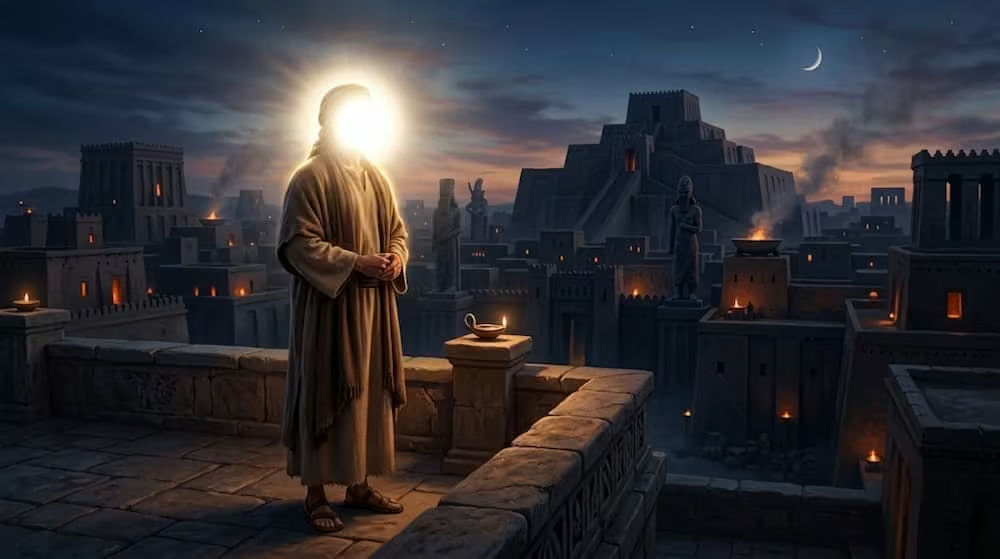
The moment pure monotheism awakened in the heart of darkness.
Prophet Ibrahim عليه السلام’s disposition also included deep compassion for his people. Even as he rejected their idolatry, he approached his father Azar and his community with wisdom and gentle admonition, hoping to guide them toward monotheism. This balance of firm conviction and merciful invitation became a hallmark of his prophethood.
In the hostile environment of the City of Idols, where challenging tradition could cost one’s life, his courage and compassion prepared him for the greater trials that lay ahead, including his eventual confrontation with Nimrod. The Emergence of the Hanif was already taking root in his heart and actions.
The spiritual inclination of young Prophet Ibrahim عليه السلام was the seed from which the tree of pure monotheism would grow. His character, nature, mindset, and inner qualities combined to create the perfect vessel for this divine mission. While Babylon remained trapped in idolatry and political absolutism, his heart and mind were already ascending toward the light of tawhid.
His example continues to guide believers: cultivate a questioning mind, a pure heart, and an unwavering inclination toward Allah alone, no matter how pervasive the idolatry of one’s surroundings may be. The early disposition of Prophet Ibrahim عليه السلام thus reveals that The Emergence of the Hanif begins within the individual soul long before it confronts society.
Page 1