
Hazrat Ibrahim Khalilullah: Friend of Allah in Islam
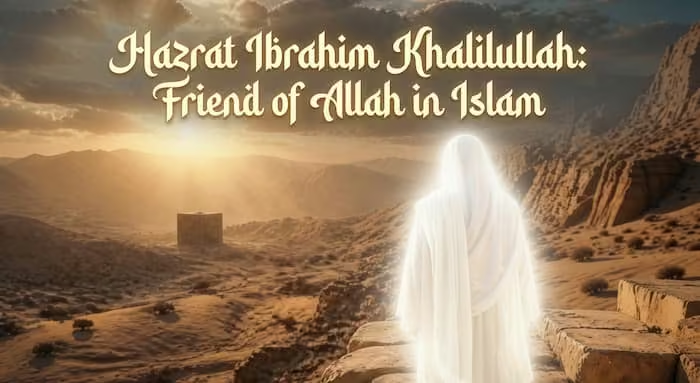
Hazrat Ibrahim Khalilullah: The pure and devoted Friend of Allah, standing in humble reverence before the sacred House.
Introduction: Hazrat Ibrahim Khalilullah
Hazrat Ibrahim Khalilullah (A.S.) is revered as one of the most honored and beloved prophets in Islamic tradition, celebrated for his unwavering commitment to pure monotheism (Tawhid), exceptional moral fortitude, and profound, unshakeable faith in Allah Subhanahu wa Ta’ala. Affectionately known by the distinguished title of Khalilullah—the intimate friend of Allah—his life story is replete with inspiring episodes that exemplify ultimate devotion, immense personal sacrifice, and resolute steadfastness against trials and tribulations.
The Noble Qur’an dedicates significant portions of its text to narrating his journey in multiple Surahs, such as Al-Baqarah, Al-An’am, and Maryam, presenting him not merely as a historical figure but as a timeless role model whose principles of faith, patience, and submission to divine will serve as a guiding light for believers across all eras and cultures.
From his courageous stand against idolatry in his homeland to the miraculous events involving the fire of Nimrod and the construction of the sacred Kaaba alongside his son Ismail (A.S.), Hazrat Ibrahim’s legacy continues to inspire millions to uphold the oneness of God and live a life of piety and righteousness.

Lineage and Early Life - Hazrat Ibrahim Khalilullah
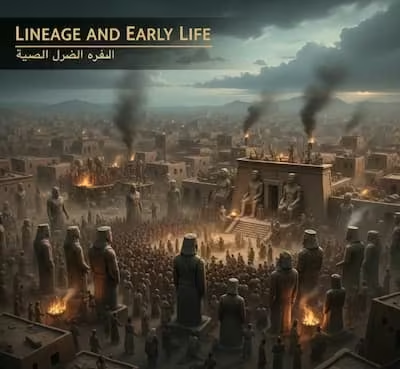
Lineage and Early Life: The idolatrous ancient world that shaped the early years of Hazrat Ibrahim Khalilullah.
Hazrat Ibrahim Khalilullah (A.S.) was born into a community that had strayed far from the path of truth, immersed deeply in the worship of idols and multiple false gods. His father, Azar, played a significant role in this idolatrous society, as he was involved in the crafting and promotion of these man-made deities that held no real power.
Nevertheless, from the very beginning, Hazrat Ibrahim Khalilullah (A.S.) was blessed by Allah with a remarkably pure heart, free from the stains of polytheism, and a sharp, questioning mind that sought answers beyond the superficial beliefs of his people.
Hazrat Ibrahim Khalilullah displayed extraordinary wisdom and a deep sense of reflection even as a young child. Hazrat Ibrahim Khalilullah could not reconcile the illogical practices he witnessed daily. People would prostrate themselves before statues carved from wood and stone, offering them food, drink, and devotion, yet these idols remained silent, motionless, and utterly incapable of responding or interceding.
This absurdity sparked in him a profound sense of inquiry. Hazrat Ibrahim Khalilullah began to reflect deeply upon the wonders of creation—the radiant sun that dominates the daytime sky, the luminous moon that beautifies the night, and the innumerable stars that twinkle across the vast expanse of the heavens.
Observing how each of these celestial bodies followed a precise and unerring course, rising and setting in perfect harmony, he concluded that they too were subservient creations rather than objects worthy of worship. Hazrat Ibrahim Khalilullah realized that only the Supreme Being who orchestrates this magnificent order could be the true God, worthy of worship alone.
This innate quest for truth was divinely nurtured, as Allah beautifully describes in the Qur’an the moment He revealed to Hazrat Ibrahim Khalilullah (A.S.) the signs of the universe:
“Thus did We show Ibrahim the realm of the heavens and the earth so that he may be among those with sure faith.”
(Surah Al-An‘am 6:75)
Through this transformative realization, rooted in both rational reflection and divine inspiration, Hazrat Ibrahim Khalilullah (A.S.) established the unshakeable foundation for his prophetic mission. He would go on to spend his life tirelessly guiding humanity away from the falsehood of idol worship and polytheism, calling them instead to the pure and sincere worship of the One and Only Creator—the Lord of all worlds. His early spiritual awakening thus became the bedrock upon which he built a legacy of unwavering monotheism that continues to inspire billions to this day.
A Courageous Voice Against Idolatry - Hazrat Ibrahim Khalilullah
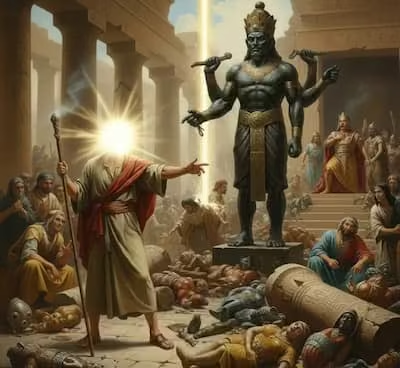
A Courageous Voice Against Idolatry: Hazrat Ibrahim boldly challenges the idols of his time with divine strength.
Prophet Hazrat Ibrahim Khalilullah (A.S.), renowned for his unyielding faith, profound wisdom, and fearless commitment to truth, stood as a courageous voice against the deep-rooted idolatry that engulfed his people and the oppressive tyranny of King Nimrod.
One of the most striking and defining episodes of his prophetic mission unfolded inside the grand temple of idols. With extraordinary courage and strategic insight, he shattered every idol except the largest one, deliberately leaving it intact.
This powerful act served as a vivid, visual sermon that exposed the utter helplessness, vulnerability, and complete powerlessness of these man-made gods, which could neither defend themselves nor benefit their worshippers in any way.
When the furious people demanded an explanation for the destruction, Hazrat Ibrahim Khalilullah (A.S.) responded with remarkable composure and divine wisdom. The Holy Qur’an records his reply in Surah Al-Anbiya’:
“He said, ‘Rather, this biggest one did it. Ask them if they can speak.’”
(21:63)
This clever yet profound retort highlighted the absurdity of idol worship and invited his people to reflect on the lifeless nature of their deities.
Instead of accepting this clear message and embracing the truth of Tawhid (the Oneness of Allah), the people stubbornly rejected it. In their rage, they sentenced the noble Prophet to a horrific punishment—throwing him into a massive, raging fire. Yet Allah, in His infinite mercy and supreme power, intervened with a miraculous command that transformed the very flames:
“We said: O fire, be coolness and safety for Ibrahim.”
(Surah Al-Anbiya’ 21:69)
According to classical tafsir (such as Ibn Kathir), this command of Allah completely changed the nature of the fire — it became cool and safe only for Hazrat Ibrahim Khalilullah (A.S.), while remaining a fire for others, showing Allah’s absolute power over His creation. The fire that was meant to destroy him became a source of peace, coolness, and complete protection, leaving him entirely unharmed.
This awe-inspiring miracle stands as a timeless symbol of Allah’s divine protection and loving care for those who stand firm upon the truth. It continues to inspire believers across all generations to follow the example of Prophet Ibrahim (A.S.)—to uphold monotheism with courage, wisdom, and unwavering faith, no matter the opposition, trials, or persecution they may face.
Hazrat Ibrahim Khalilullah - Migration for the Sake of Allah
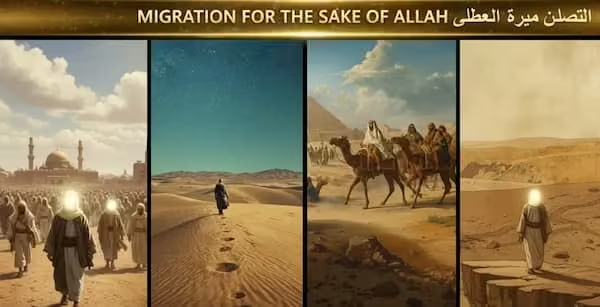
Migration for the Sake of Allah: Epic scenes of sacrifice, guidance, and the journey of faith through the desert.
Throughout his life, Hazrat Ibrahim Khalilullah (A.S.) migrated from one land to another—Mesopotamia, the Levant, and eventually the Arabian desert—responding only to Allah’s commands. His migrations helped spread the message of pure monotheism and laid the foundation for future prophets. Emerging from a society deeply rooted in idol worship in ancient Mesopotamia, Hazrat Ibrahim Khalilullah (A.S.) courageously challenged the polytheistic beliefs of his people and his own father by destroying their idols, an act that provoked severe persecution.
He was thrown into a great fire by order of the tyrant Nimrod, yet Allah made the flames cool and peaceful for His faithful servant. In obedience to his Lord’s command, he migrated to the blessed lands of the Levant, settling there with his family and persistently calling humanity to the worship of the One and Only God.
Further divine instructions led him to undertake another significant journey to the desolate Arabian desert, where he left his wife Hajar and their young son Ismail under Allah’s protection. This ultimate test of faith resulted in the miraculous appearance of the Zamzam well and the subsequent building of the Kaaba, the sacred sanctuary dedicated to monotheism.
These migrations played a crucial role in disseminating the light of Tawhid across different regions and established the prophetic lineage that would guide future generations. The noble spirit of migrating for the sake of Allah is eloquently expressed in the Quranic verse where Hazrat Ibrahim Khalilullah (A.S.) declares:
“I am going to my Lord; He will guide me.”
(Surah As-Saffat 37:99).
His inspiring example continues to teach believers the importance of prioritizing divine commands above all else, often entailing sacrifice and relocation to uphold and spread the truth.
A Family of Deep Faith
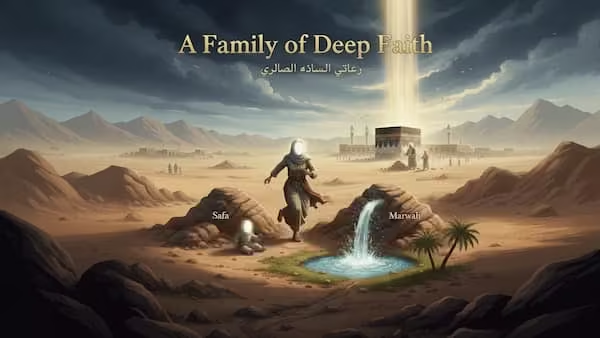
A Family of Deep Faith: Hajar’s courageous Sa’i between Safa and Marwah brings the miraculous Zamzam spring.
The story of Hajra (A.S.) and her infant son Isma’il (A.S.) in the barren valley of Makkah stands as one of the most profound and moving examples of tawakkul—complete trust and reliance upon Allah—in the face of overwhelming hardship. When Prophet Ibrahim (A.S.), in perfect obedience to the divine command, left his wife Hajra (A.S.) and their young baby Isma’il (A.S.) in this desolate, waterless valley near the future site of the Sacred House, he departed with only the minimal provisions Allah had permitted, placing his entire family in the care of their Creator.
As the days passed and their scant supplies of water and food were exhausted under the scorching desert sun, Hajra (A.S.) did not despair, complain, or question the wisdom of Allah’s decree. Instead, with a heart full of faith and a mother’s fierce love, she began running back and forth between the two hills of Safa and Marwah, scanning the horizon for water or any passing caravan that might offer help.
She repeated this exhausting and desperate search seven times, each step an act of pure supplication and unwavering trust in her Lord. This historic display of perseverance, courage, and devotion is eternally commemorated in the Hajj pilgrimage through the ritual of Sa’i, which millions of Muslims perform every year to honor her example and draw spiritual strength from her story.
In response to her sincere prayers and the innocent cries of the thirsty child, Allah miraculously caused the sacred spring of Zamzam to gush forth abundantly from beneath the feet of baby Isma’il (A.S.). This divine gift of pure, life-giving water not only saved their lives but also attracted birds from the sky and, eventually, the tribe of Jurhum, who recognized the clear blessing of Allah and settled in the valley.
What was once an empty, lifeless desert was thus transformed into a thriving and blessed settlement—the very foundation of the holy city of Makkah and the future site where Ibrahim (A.S.) and Isma’il (A.S.) would later raise the walls of the Kaaba.
The Qur’an beautifully captures this moment of profound trust when Ibrahim (A.S.) prayed:
“Our Lord, I have settled some of my descendants in a barren valley near Your Sacred House…”
(Surah Ibrahim 14:37).
This timeless narrative continues to inspire believers to place their complete reliance upon Allah, knowing that He never abandons those who trust in Him.
The Supreme Test – The Command to Sacrifice
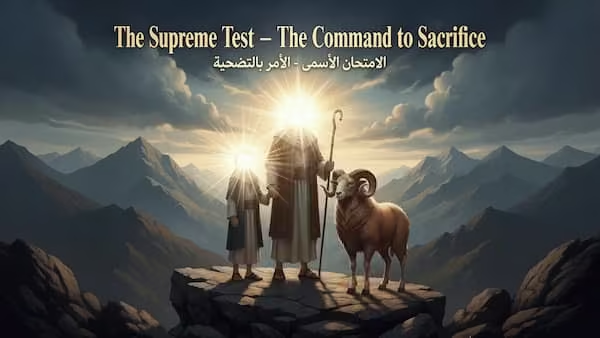
The Supreme Test – The Command to Sacrifice: Ibrahim’s complete submission as he prepares to obey Allah with his beloved son.
One of the greatest trials in human history was the divine command given to Prophet Hazrat Ibrahim Khalilullah (peace be upon him) to sacrifice his beloved son Ismail (peace be upon him). This extraordinary test of faith demanded the ultimate form of submission to Allah’s will, revealing the pinnacle of devotion, trust, and surrender.
Both father and son accepted the command with complete willingness and serenity, demonstrating that true faith means placing Allah’s pleasure above even the most precious human bonds and personal desires. Their mutual consent reflected the very essence of Islam — total submission to the Creator, no matter how severe the trial.
Allah describes this event with profound clarity:
“He said, ‘O my son, indeed I have seen in a dream that I must sacrifice you; so see what you think.’ He said, ‘O my father, do as you are commanded. You will find me, if Allah wills, among the patient.”
(Surah As-Saffat 37:102)
Classical scholars (including Ibn Kathir) note that this conversation shows the extraordinary willingness of both father and son. Ismail (A.S.) did not hesitate or question the command; his immediate acceptance demonstrated pure submission and trust in Allah.
The son’s dignified reply beautifully embodies the virtues of patience (sabr), trust in Allah’s wisdom, and cheerful obedience. Before the sacrifice could be carried out, Allah, in His infinite mercy and wisdom, intervened and replaced the son with a ram, thereby ransoming him and turning a moment of unimaginable hardship into one of divine relief and eternal reward.
“And We ransomed him with a great sacrifice.”
(Surah As-Saffat 37:107)
Tafsir scholars explain that this “great sacrifice” (the ram) became a lasting symbol of Allah’s mercy and a reminder that sincere obedience is always rewarded. This divine intervention not only preserved the life of young Ismail but also established a timeless legacy of unwavering faith that continues to inspire believers across generations. It teaches that Allah never burdens a soul beyond its capacity and that sincere obedience, even in the face of the greatest tests, brings immense spiritual elevation and blessings.
Muslims commemorate this profound act of devotion every year during the blessed festival of Eid al-Adha. Through the ritual of Qurbani (sacrifice), they symbolically reenact Prophet Ibrahim’s willingness to give up what was dearest to him for the sake of Allah. Animals such as sheep, goats, cows, or camels are sacrificed, and the meat is distributed among family, friends, and especially the poor and needy.
This practice reinforces the core values of charity, empathy, gratitude, and community solidarity. Eid al-Adha serves as a powerful annual reminder that true success lies in prioritizing faith over worldly attachments, cultivating patience during trials, and trusting completely in Allah’s perfect plan. The story of this supreme test continues to inspire millions to strengthen their own submission, knowing that sincere devotion is always met with divine mercy and reward.
Rebuilding the Kaaba
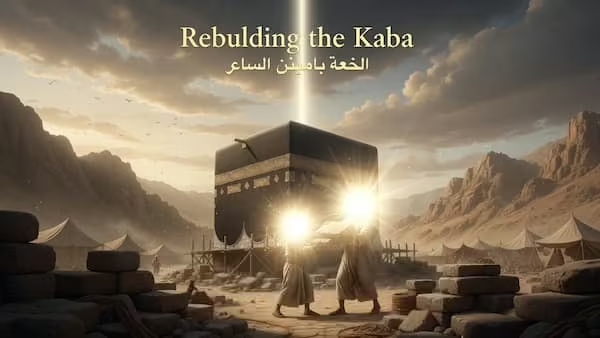
Rebuilding the Kaaba: Prophet Ibrahim and his son Ismail construct the sacred House of Allah under divine light.
One of the most defining and spiritually uplifting achievements of Prophet Ibrahim’s (A.S.) noble mission was the sacred rebuilding of the Kaaba in the blessed valley of Mecca, carried out together with his devoted son, Prophet Isma’il (A.S.).
In direct obedience to Allah’s divine command, these two noble prophets worked with tireless dedication, sincerity, and love to raise the foundations of the ancient House of Allah. Far more than a physical reconstruction, their labor was a profound act of worship: they purified the sacred site of every trace of idolatry and polytheism, rededicating it exclusively to the worship of the One True God.
This monumental effort established the Kaaba as the eternal spiritual center of monotheism (Tawhid) for all humanity — a unifying beacon that would later become the Qibla (direction of prayer) for Muslims worldwide and the focal point of the annual Hajj pilgrimage, drawing believers from every nation in submission and unity.
The Glorious Qur’an beautifully preserves this historic moment in Surah Al-Baqarah:
“And [mention] when Ibrahim raised the foundations of the House, along with Isma’il, saying: ‘Our Lord, accept this from us. Indeed, You are the Hearing, the Knowing.’”
(Surah Al-Baqarah 2:127)
While engaged in this blessed construction, Prophet Hazrat Ibrahim Khalilullah (A.S.) also lifted his hands in heartfelt supplication, praying for a righteous messenger to arise from among their descendants in that sacred land. He beseeched his Lord:
“Our Lord, raise among them a messenger from themselves who will recite to them Your verses and teach them the Book and wisdom and purify them. Indeed, You are the Exalted in Might, the Wise.”
(Surah Al-Baqarah 2:129)
This profound and far-sighted prayer was graciously accepted by Allah and found its perfect fulfillment centuries later through the coming of the final Prophet, Muhammad (PBUH). Born in the shadow of the very Kaaba that Ibrahim and Isma’il had rebuilt, Prophet Muhammad (PBUH) restored its original purity by cleansing it of idols and revived the pristine message of Tawhid for all mankind.
The legacy of this sacred rebuilding continues to inspire believers today, reminding us of the power of sincere faith, the beauty of family working together in righteousness, the strength of heartfelt dua, and the unbroken chain of prophethood that links Hazrat Ibrahim Khalilullah (A.S.) to Muhammad (PBUH) in guiding humanity toward truth, unity, and divine mercy. 🤲
Khalilullah – The Title of Divine Friendship
Among all honors, one stands unmatched: Allah named Ibrahim Khalilullah ((A.S.) His friend).
Khalilullah – The Title of Divine Friendship: The highest honor given to Prophet Ibrahim for his complete love and submission to Allah.
“And Allah took Ibrahim as a friend.” (Surah An-Nisa’ 4:125)
Classical scholars describe this title as a special rank of closeness and pure love for Allah — a friendship based on complete sincerity, humility, and total reliance on Him, which only a few of the greatest prophets were granted.
This noble title of Khalilullah — the intimate friend of Allah — bestowed directly by the Divine upon Hazrat Ibrahim Khalilullah (A.S.), signifies a relationship of extraordinary closeness, love, and spiritual intimacy that few have ever attained.
It beautifully reflects his unmatched sincerity in every aspect of his life, where his worship, sacrifices, and obedience were performed purely for the pleasure of Allah, completely free from hypocrisy, ostentation, or any desire for worldly recognition.
His profound humility is evident in his constant turning to his Lord in supplication, his gentle acknowledgment of his own limitations, and his deep awareness of standing before the infinite majesty of the Creator.
Above all, this divine friendship highlights his absolute and unwavering reliance on Allah, as he entrusted every affair of his life to divine wisdom and protection — whether confronting the idols of his people, walking calmly into the blazing fire, or submitting wholeheartedly to the command of sacrificing his beloved son Ismail (A.S.).
Through these radiant qualities of sincerity, humility, and total dependence on his Lord, Prophet Ibrahim (A.S.) not only earned the highest honor of divine friendship but also left behind a timeless legacy that continues to inspire believers across generations to purify their intentions, soften their hearts in humility, and place their complete trust in Allah, thereby drawing nearer to the Creator in a bond of love, devotion, and true friendship.
Legacy and Influence
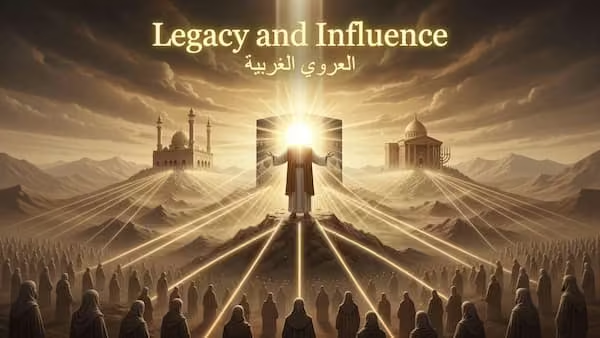
Legacy and Influence: The timeless message of Prophet Ibrahim continues to illuminate hearts across generations and faiths.
Hazrat Ibrahim Khalilullah (A.S.), revered as the patriarch and father of the Abrahamic faiths, stands as a towering and unifying figure whose legacy profoundly shapes Islam, Judaism, and Christianity. For Muslims, he embodies the highest ideals of guidance, extraordinary patience through relentless trials, and complete, unwavering devotion to Allah alone. The Noble Qur’an presents him as the perfect and comprehensive role model for all humanity, declaring in Surah An-Nahl:
“Indeed, Ibrahim was a nation—obedient to Allah, upright, and he was not of those who associate partners with Allah.”
Surah An-Nahl (16:120)
This powerful verse portrays him as an entire community of virtue in himself—a lone champion of truth who single-handedly upheld Tawhid against widespread idolatry and oppression.
His inspiring life story continues to illuminate the path of faith for billions. From courageously rejecting his people’s idol worship and surviving the blazing fire of the tyrant Nimrod, to migrating for the sake of Allah and raising the foundations of the sacred Kaaba in Makkah with his son Hazrat Ismail (A.S.), every chapter of his journey teaches timeless lessons of sacrifice, trust in divine wisdom, and steadfast perseverance.
These historic events not only established the core rituals of Hajj—such as the Sa’i between Safa and Marwa and the stoning of the Jamarat—but also reinforced the eternal message of pure monotheism. His heartfelt supplications recorded in the Qur’an still echo in the hearts of believers, seeking righteous progeny and a flourishing ummah grounded in justice and faith.
To this day, Muslims honor his blessed memory daily by reciting Durood Hazrat Ibrahim (A.S.) in their prayers, earnestly asking Allah to send His choicest blessings and peace upon Hazrat Ibrahim (A.S.), his family, and—by extension—the Prophet Muhammad (S.A.W.) and his family. This beautiful invocation bridges prophetic lineages and keeps his luminous legacy alive in the spiritual life of the ummah across generations.
Conclusion
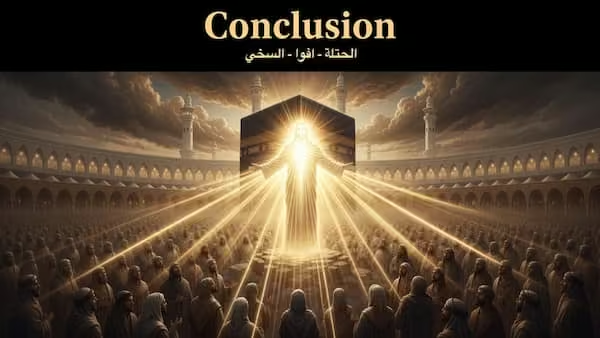
Conclusion: The light of Ibrahim’s faith continues to unite hearts around the Kaaba across generations.
The exemplary life of Hazrat Ibrahim (A.S.), honored as Khalilullah—the intimate Friend of Allah—shines as a radiant beacon of pure and unwavering faith, extraordinary moral courage, and absolute trust in the infinite wisdom of Allah Almighty.
From his fearless stand against idolatry and his miraculous salvation from the blazing fire to his ultimate test of obedience in being willing to sacrifice his beloved son, his journey embodies the highest ideals of submission and devotion.
His timeless example continues to inspire believers across the globe and throughout the ages, teaching us that true and lasting success lies not in worldly gains but in wholehearted submission to Allah, steadfast commitment to truth even in the face of adversity, patient endurance of every trial, and hopeful reliance upon the mercy and guidance of the Creator.
May his noble legacy forever illuminate the path of righteousness for all who seek spiritual fulfillment and divine pleasure.